About the ICIJ

The International Consortium of Investigative Journalists is an active global network of 160 reporters in more than 60 countries who collaborate on in-depth investigative stories.

Founded in 1997, ICIJ was launched as a project of the Center for Public Integrity to extend the Center’s style of watchdog journalism, focusing on issues that do not stop at national frontiers: cross-border crime, corruption, and the accountability of power. Backed by the Center and its computer-assisted reporting specialists, public records experts, fact-checkers and lawyers, ICIJ reporters and editors provide real-time resources and state-of-the-art tools and techniques to journalists around the world.

Our advisory committee consists of some of the biggest names in investigative journalism: Bill Kovach, Rosental Calmon Alves, Phillip Knightley, Gwen Lister, Goenawan Mohamad, Reginald Chua and Brant Houston.

Why we exist

The need for such an organization has never been greater. Globalization and development have placed extraordinary pressures on human societies, posing unprecedented threats from polluting industries, transnational crime networks, rogue states, and the actions of powerful figures in business and government.

The news media, hobbled by short attention spans and lack of resources, are even less of a match for those who would harm the public interest. Broadcast networks and major newspapers have closed foreign bureaus, cut travel budgets, and disbanded investigative teams. We are losing our eyes and ears around the world precisely when we need them most.

Meanwhile, in many developing countries, investigative reporters are killed, threatened, or imprisoned with alarming regularity. Amazingly unbowed by these life-and-death realities, journalists are in dire need of help from colleagues abroad, many of whom do similar work and can offer support.

What we do

ICIJ projects are typically staffed by teams ranging from as few as three to as many as 20 reporters spread around the world. These journalists work with counterparts in other countries and with our Washington, D.C., staff to report, edit, and produce groundbreaking multimedia reports that adhere to the highest standards of fairness and accuracy.

Over the years, our teams have exposed smuggling by multinational tobacco companies and by organized crime syndicates; investigated private military cartels, asbestos companies, and climate change lobbyists; and broke new ground by publicizing details of Iraq and Afghanistan war contracts.

Who we work with

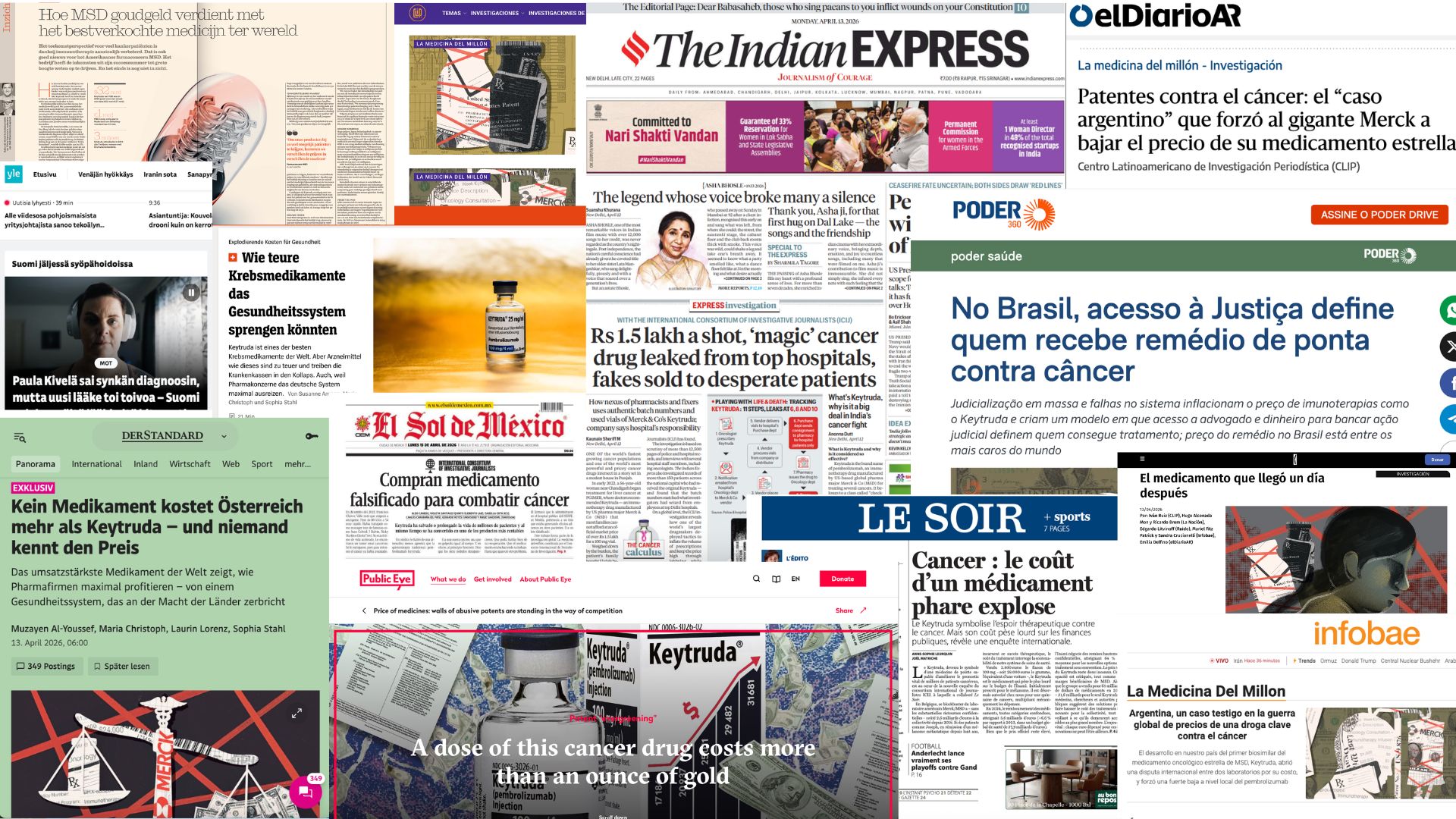
To release its findings, ICIJ works with leading news organizations worldwide.  Our stories have appeared in a dozen languages and with such partners as the BBC World Service and BBC World TV, the International Herald Tribune, Le Monde (France), El Mundo (Spain), Trouw (the Netherlands), El Pais (Spain), Folha de Sao Paulo (Brazil), Le Soir (Belgium), Novaya Gazeta (Russia), the South China Morning Post (Hong Kong), Stern (Germany), The Guardian (UK), The Sunday Times (UK), Proceso (Mexico), the Huffington Post (USA), The Age (Australia) and The Sydney Morning Herald (Australia).

These unique collaborations have been honored repeatedly. Among ICIJ’s awards: George Polk Award, Overseas Press Club Award, John Oakes Award, Editor and Publisher Award, Society of Professional Journalists and the Investigative Reporters and Editors Award.

Outreach

In addition to ICIJ’s in-depth reporting, the consortium plays a key role in bringing together investigative journalists from around the world. ICIJ reaches thousands of followers in dozens of countries with news on the latest reporting tools and techniques, awards, fellowships, and journalists under fire, via:

Every two years, ICIJ sponsors a global competition, the Daniel Pearl Awards for Outstanding International Investigative Reporting – the only prize that specifically recognizes the best cross-border investigative journalism.

Our supporters

Cross-border investigative journalism is among the most expensive and riskiest in the world.

Recent ICIJ funders include: Adessium Foundation, Open Society Foundations, The David and Lucile Packard Foundation, Oak Foundation, Pew Charitable Trusts and Waterloo Foundation.

We welcome individual donations in support of our work. To make a gift online or to find out more about donating click here.

We want to hear from you

ICIJ is open to new story ideas, as well as outstanding investigative journalists interested in collaborating with us. Please don’t hesitate to contact us with your ideas.

If you want to be considered for ICIJ membership please send us your CV and clips.

Our Staff

Gerard Ryle

Director
Gerard Ryle leads the ICIJ’s headquarters staff in Washington, D.C., as well as overseeing the consortium’s more than 160 member journalists in more than 60 countries. Before joining as the ICIJ’s first non-American director in September 2011, Ryle spent 26 years working as a reporter, investigative reporter and editor in Australia and Ireland, including two decades at The Sydney Morning Herald and The Age newspapers. He uncovered some of the biggest stories in Australian journalism, winning that country’s highest journalism award four times. He is a former deputy editor of The Canberra Times and a former Knight-Wallace Journalism Fellow at the University of Michigan. He is the author of a critically acclaimed book based on one of his former investigations, Firepower, and has contributed to two other books on journalism, published in the U.S. and Australia.

Marina Walker Guevara

Deputy Director
Marina Walker Guevara is ICIJ’s deputy director. A native of Argentina, she has reported from a half-dozen countries and her investigations have won and shared more than 15 national and international awards, including from Investigative Reporters and Editors, Overseas Press Club and the Society of Professional Journalists. Over a 15-year career, she has written about environmental degradation in Latin America by multinational corporations; shadowy U.S. government HIV/AIDS prevention programs in Africa, the global black market in endangered bluefin tuna and the cigarette mafia in the Tri-Border Area, among other topics. In March 2006 she was awarded the European Commission Lorenzo Natali Prize (Latin America and the Caribbean region) for her investigation about environmental damage caused in Peru by a U.S.-based mining company. She graduated magna cum laude from Universidad Nacional de Cuyo in Mendoza, Argentina, with a bachelor’s degree in communication sciences, and earned a master’s degree in journalism from the University of Missouri.

Michael Hudson

Senior Editor
Michael Hudson, USA, is a senior editor at ICIJ. His two decades of work on mortgage and banking fraud has prompted media critics to call him the reporter "who beat the world on subprime abuses" and the "guru of all things predatory lending." He previously worked as a reporter for the Wall Street Journal and as an investigator for the Center for Responsible Lending. Hudson has also written for Forbes, the New York Times, the Los Angeles Times and Mother Jones. His work has won many honors, including a George Polk Award for magazine reporting, a John Hancock Award for business journalism and accolades from the National Press Club, the White House Correspondents’ Association, the American Bar Association and the New York State Society of CPAs. He edited the award-winning book Merchants of Misery and appeared in the documentary film Maxed Out. His latest book, THE MONSTER: How a Gang of Predatory Lenders and Wall Street Bankers Fleeced America—and Spawned a Global Crisis, was named 2010 Book of the Year by Baltimore City Paper and called "essential reading for anyone concerned with the mortgage crisis" by Library Journal. His recent series of stories for the Center, "The Great Mortgage Cover-Up," has been selected to appear in Columbia University Press's Best Business Writing, 2012.

Kimberley Porteous

Digital Editor
Kimberley Porteous is ICIJ’s digital editor. She is the former digital editor of The Canberra Times and multimedia editor of The Sydney Morning Herald. Her digital journalism has been awarded Australia’s highest journalism prize, the Walkley Award, three times, and has twice been a finalist. In 2011 she was an Award judge.

Advisory Committee

Bill Kovach, United States, former curator of the Nieman Foundation for Journalism at Harvard University and an American newspaperman for 30 years, is the North American representative and chair of the ICIJ Advisory Committee.

Kovach has been a journalist and writer for 40 years, including 18 years as a reporter and editor for The New York Times. As an editor, Kovach supervised reporting projects that won four Pulitzer Prizes, including two during his two-year tenure as editor of the Atlanta Journal-Constitution, the first Pulitzers awarded to that paper in 20 years.

Kovach was a 1988-89 Nieman fellow at Harvard University and remained as curator of the Nieman Foundation journalism fellowship program until 2000.

Among his many other awards are the Sigma Delta Chi Award for contributions to journalism research in 2000, the National Mental Health Award in 1968, the New York State Bar Association Award in 1968, the AEJMC Professional Freedom and Responsibility Award in 1992, the Sigma Delta Chi First Amendment Award in 1996, the Goldsmith Career Award for Excellence in Journalism in 2000, and the Elijah Parish Lovejoy Award, which was accompanied by an honorary doctorate from Colby College.

Kovach served on Pulitzer juries from 1987-1990 and is a board member of the Committee to Protect Journalists.

He is co-author of Warp Speed: America in the Age of Mixed Media, The Elements of Journalism: What Newspeople Should Know and the Public Should Expect, and Blur: How to Know What's True in the Age of Information Overload.

Kovach is a long-time advisory board member of the Center for Public Integrity.

Rosental Calmon Alves, United States/Brazil, is a journalism professor at the University of Texas at Austin, where he holds the first John S. & James L. Knight Chair in International Journalism. For a decade, Alves worked as a foreign correspondent for Brazil’s daily newspaper, Jornal do Brasil, reporting from Spain, Argentina, Mexico, and the United States. He taught journalism at two Rio de Janeiro universities and in 1987-88 became the first Brazilian to be selected as a Nieman Fellow at Harvard University. As a correspondent and editor, he has participated in or directed several investigative reporting projects. Alves is the Latin American representative on the Advisory Committee.

Phillip Knightley, Britain, was a member of The Sunday Times' Insight team in its heyday, and it was there that he first uncovered the Kim Philby spy scandal. He later discovered that the newspaper’s executives had informed British intelligence about the activities of their journalists.

The Australian-born Knightley also played a central role in investigating and exposing thalidomide birth defects and later detailed the scandal, which came to be known as the Profumo affair, in his 1987 book An Affair of State.

The author of nine books, Knightley wrote A Hack’s Progress about his life as an investigative reporter in 1998. In 2000, Knightley released his latest book, Australia: A Biography of a Nation.

He is the European representative on the Advisory Committee.

Read Phillip Knightley's essay on how to be a great investigative reporter in ICIJ's Secrets of the Masters series.

Gwen Lister, Namibia, founded The Namibian in 1985 during apartheid colonialism in the country. The newspaper and staff were consistently targeted by right-wing elements and security forces because of the perception that the newspaper supported the liberation movement. Lister was jailed twice, in 1984 under the Official Secrets Act, and in June 1988, when she was detained without trial and denied access to a lawyer. Authorities jailed her the second time in an attempt to force her to reveal the source of a secret document she had published, which proposed sweeping new powers for the police. She was four months pregnant at the time. Attacks on the newspaper and harassment of its staff culminated in an arson attack that destroyed the offices of The Namibian in October 1988.

After independence in 1990, the newspaper was again targeted by right-wing elements after a front-page report about a possible coup attempt against the new government. The editorial offices were damaged in a phosphorous grenade firebombing. In these and other bombings, The Namibian never missed an edition.

The role of The Namibian in pre-independence Namibia has been honored by a number of international awards. In 2000, Lister was named one of 50 World Press Freedom Heroes of the last half century by the International Press Institute. In 1992, she was awarded a Committee to Protect Journalists’ International Press Freedom Award and the Press Freedom Award of the Media Institute of South Africa.

In October 2011, after 26 years at the helm of The Namibian Lister handed over the reins to Tangeni Amupadhi. At the same time she formalized the non-profit Namibia Media Trust which owns the newpaper, and appointed other Trustees. Lister is Executive Director of The Free Press of Namibia (Pty) Ltd and Chairs the Trust - in terms of which the profits of The Namibian are ploughed back into promotion of free and independent press, excellence and training in journalism in the wider media community.

Lister was a 1996 Nieman fellow at Harvard.

Goenawan Mohamad, Indonesia, is founder and editor of Tempo magazine, Indonesia's most-respected newsmagazine. It was banned by the Suharto government in 1994 after publishing details of the government’s purchase of aging East German destroyers, a confidential subject of dispute among Suharto’s cabinet members. In 1995, Mohamad founded the Institute for the Studies on Free Flow of Information (ISAI) which produced alternative media intended to circumvent censorship. Mohamad later formed the Alliance of Independent Journalists, the only independent journalism organization in Indonesia. Following Suharto’s resignation in May 1998, Mohamad led a group of reporters in restarting Tempo online and in print. Mohamad was a 1990 Nieman fellow at Harvard University and in 1997 received the Nieman fellows’ Louis Lyons Award for Conscience and Integrity in Journalism. In 1998, he was awarded the Committee to Protect Journalists’ International Press Freedom Award. Mohamad is a visiting history professor at the University of California at Berkeley this year, where he will teach courses in Indonesian and Southeast Asian culture. Mohamad is the Asian representative on the Advisory Committee.

Reginald Chua is Editor, Data and Innovation at Thomson Reuters, based in New York. From July 2009 to March 2011, he was Editor-in-Chief of the South China Morning Post, responsible for the editorial operations of the Hong Kong-based news media company. Prior to that, he had a 16-year run at The Wall Street Journal, including as a Deputy Managing Editor in New York, where he managed the global newsroom budget, supervised the graphics team, and helped develop the paper’s computer-assisted reporting capabilities. He began a 16-year career at the Journal as a correspondent in Manila, opened the paper’s bureau in Hanoi, became the longest-serving editor of the Journal’s Hong Kong-based Asian edition, then moved to New York, where his initial duties were to manage the paper’s global newsroom budget and administration. During his eight-year tenure as editor of the Asian Journal, the paper won numerous Society of Publishers in Asia awards for editorial excellence; staff at the paper also won a Pulitzer Prize and an Overseas Press Club of America award. He also covered the Philippines for the Straits Times, worked at Reuters in Singapore, and was a television and radio journalist at the then-Singapore Broadcasting Corp. A native of Singapore, Reginald graduated with a Master’s in Journalism from Columbia University and a Bachelor’s in Mathematics from the University of Chicago.

Brant Houston, United States, is a journalism professor at the University of Illinois at Urbana-Champaign, where he holds the John S. & James L. Knight Chair in Investigative Reporting. Houston served for more than 10 years as executive director of Investigative Reporters and Editors (IRE), a nonprofit organization of more than 4,000 members, and as a professor at the University of Missouri School of Journalism. He co-founded the Global Investigative Journalism Network in 2003 and is chair of the recently formed Investigative News Network. Before joining IRE, Houston was an award-winning investigative reporter for 17 years at metropolitan papers in the United States. He is author of Computer-Assisted Reporting: A Practical Guide and co-author of The Investigative Reporter’s Handbook. He has taught investigative reporting and computer-assisted reporting in more than a dozen countries.

Stay Informed

Subscribe to our email newsletter and be the first to view our ground-breaking investigations and multimedia.

Sign Up

Transparency

The ICIJ is dedicated to ensuring all reports we publish are accurate. If you believe you have found an inaccuracy let us know.

Support Our Work

Independent, fearless investigative journalism is expensive and ICIJ relies on your support.

Please consider becoming a sponsor.