SOLITARY CONFINEMENT
Solitary confinement in ICE detention spiked during early months of the Trump administration, report finds
Six years after ICIJ’s Solitary Voices investigation, Physicians for Human Rights found over 10,000 people were placed in solitary confinement over a 14-month period.

The use of solitary confinement in immigration detention has sharply increased during the first four months of President Donald Trump’s second term, according to a new report by Physicians for Human Rights, the Peeler Immigration Lab and experts at Harvard Law School.
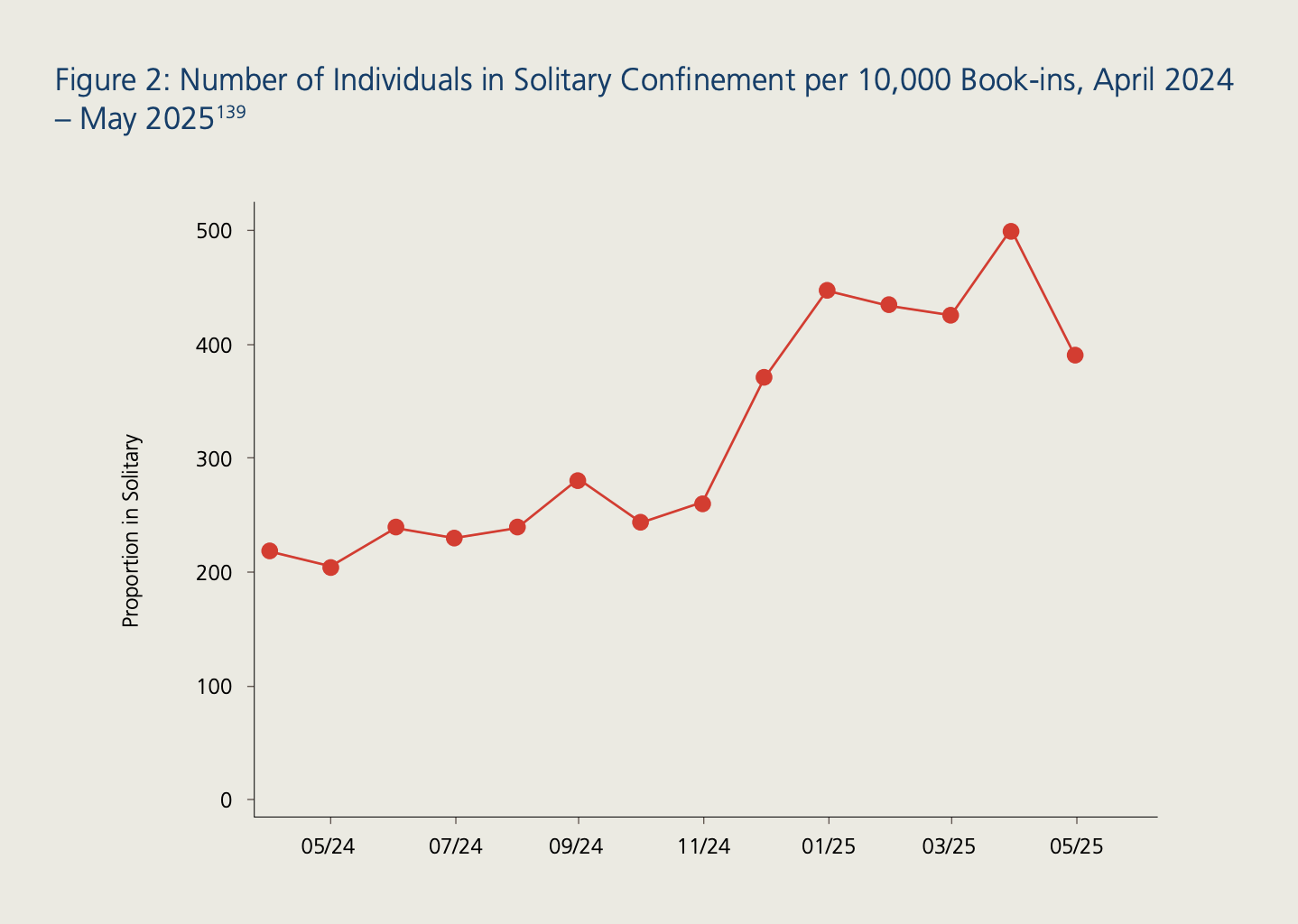
Over 14 months, up to May 2025, more than 10,000 people were placed in solitary confinement in detention facilities run by the U.S. Homeland Security Department’s Immigration and Customs Enforcement (ICE) agency, the report found.
From February to March 2025, the number of detainees subjected to the practice increased by an average of 6.5% per month, more than six times the average recorded between April and November 2024 under the Biden administration.
It appears to be becoming more and more punitive, and solitary confinement is part of that.
— Dr. Katherine Peeler, medical advisor for Physicians for Human Rights
The United Nations says solitary confinement, isolation without meaningful human contact for 22 hours or more per day, should be banned except in “very exceptional circumstances” and should never be used to isolate the mentally ill or minors. No one should be held for longer than 15 days, which the U.N. considers psychological torture. But previous reporting by ICIJ has documented ICE’s misuse and overuse of solitary confinement as a form of punishment intended only as a last resort.
“This report adds to over a decade of persistent advocacy and research,” the report said. “ICE must publicly commit to ending solitary confinement entirely.”
In 2019, the International Consortium of Investigative Journalists’ Solitary Voices investigation found that ICE detention centers had used solitary confinement to isolate thousands of the most vulnerable immigrant detainees, including people with severe mental illness or disabilities, and LGBTQI people, for weeks and months at a time. Follow-up reporting in 2020 found that ICE resorted to solitary confinement to isolate sick people during the COVID-19 pandemic.
The United States maintains the world’s largest immigration detention system, with over 60,000 people in immigration detention this August — a record high hit under the second Trump administration. Solitary confinement has been used across administrations, however. A previous Physicians for Human Rights report released in February 2024 also noted an uptick in the use of solitary confinement under the Biden administration.



But the passage of the One Big Beautiful Bill Act, which gave ICE a historic $75 billion in additional funding and quadrupled its detention budget, has increased the urgency of the report’s findings, according to Dr. Katherine Peeler, medical advisor for Physicians for Human Rights and assistant professor of pediatrics at Harvard Medical School.
“It’s important to think about this in the context of rapidly escalating detention system in the United States,” Dr. Peeler said. “It appears to be becoming more and more punitive, and solitary confinement is part of that.”
The report, based on publicly available ICE data as well as records obtained through Freedom of Information Act requests, documents how the rate of monthly increases in the use of solitary confinement during the first four months of the Trump administration is twice as high as it was between 2018 and 2023.
The analysis also found that during the first three months of 2025, people with vulnerabilities — such as those with disabilities, mental health conditions or those at risk of violence due to their sexual orientation or gender identity — were held in solitary confinement for more than twice as long as they had been over the same period in 2022.
ICE did not respond to ICIJ’s request for comment but Department of Homeland Security assistant secretary Tricia McLaughlin told The Guardian that detainee safety, security and wellbeing was “a top priority at ICE.” McLaughlin said any allegation that ICE is “weaponizing” solitary confinement against detainees was “DISGUSTING and FALSE.”
Since December 2024, new federal reporting requirements have made it mandatory for ICE to collect and report data on all solitary confinement placements, regardless of duration. But, despite the transparency measures, ICE data has continued to be notoriously barebones, and in some cases inconsistent, said Arevik Avedian, a law lecturer and the director of Empirical Research Services at Harvard Law School.
“I use, oftentimes, a web archive to be able to go back to the different versions and check and see: what are the things that are changing, and how they’re changing?” Avedian said. “There was a month during this Trump administration where the data was published, and then in the next updated version, two weeks later, that monthly information for solitary confinement disappeared, and then it was put back.”
In that way, even with some data available, ICE detention remains “a black box,” she said.
“I kind of shudder to think what it’s really like if we had a truly complete, comprehensive data set of every single placement, every single person,” Dr. Peeler said.
The report also broke down data on solitary confinement in New England, finding segregation was used to retaliate against detainees for filing grievances, sharing food or requesting access to basic necessities like showers. Between 2018 and 2023, nearly three out of four solitary confinement placements in New England lasted 15 days or longer; on average, detainees spent about a month in solitary, and some were isolated for more than a year.
In light of a forceful federal immigration crackdown and ballooning funding for the federal immigration agency, the report calls on lawmakers at all levels of government to use their powers to intervene and impose stronger oversight mechanisms in detention facilities, such as unannounced inspections or visits.
“The urgency of addressing these abuses is further heightened by ICE’s active obstruction of Congressional oversight, including denying entry to lawmakers seeking to inspect facilities in their own districts,” the report said. “ICE cannot be presently trusted to account accurately, let alone implement humane policies in its existing facilities.”