IMPACT
‘Unacceptable’: Lawmakers react to revelations from ICIJ’s Cancer Calculus investigation
In hearings around the world, politicians and experts called for inquiries into inequities surrounding Merck’s anti-cancer drug Keytruda.

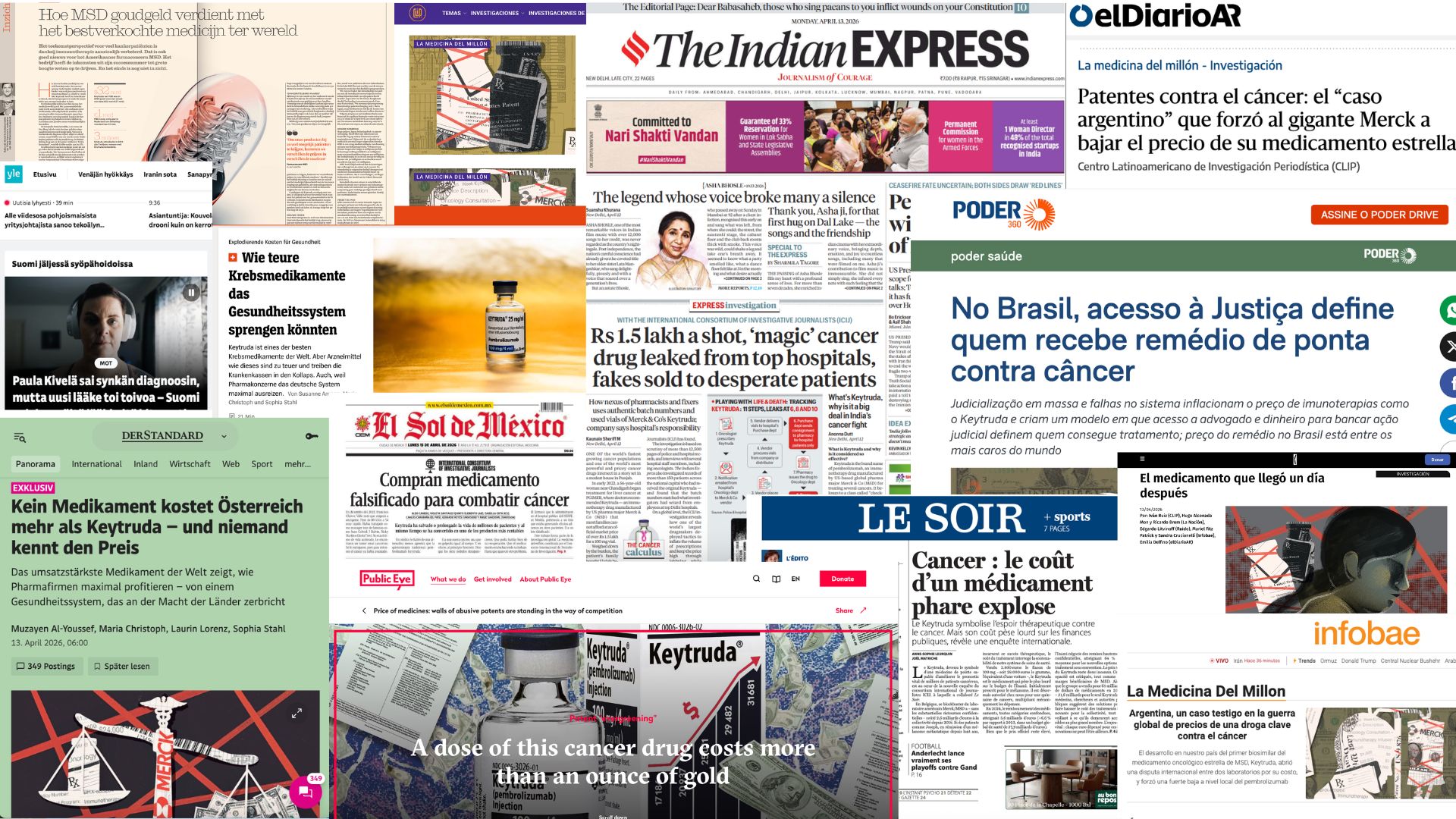
Lawmakers and experts in several countries have called for pharmaceutical companies to be more transparent about drug pricing and tax dealings following revelations from ICIJ’s Cancer Calculus.
The investigation, led by ICIJ and 47 media partners, explores how Merck & Co. — known as MSD outside the United States and Canada — keeps huge revenues flowing while pricing out many patients and governments from its blockbuster cancer drug Keytruda.
ICIJ’s investigation revealed that Merck operates with a gross lack of transparency in pricing, even as the cost of Keytruda strains public health systems and counterfeiters reap massive windfalls from duping the expensive drug. The findings have so far elicited widespread reactions from politicians, government agencies, and health and financial accountability experts.
Merck’s tax maneuvers highlighted in the U.S.
The international collaboration found that Merck reduced its U.S. taxes by recording profits in lower-tax jurisdictions. In its 2025 annual report, Merck disclosed it paid around $1.6 billion in U.S. income taxes, compared to $4.5 billion in other countries.
At a U.S. congressional hearing on corporate taxation on Tuesday, Zorka Milin, head of the Financial Accountability and Corporate Transparency Coalition, confirmed those findings.
“Despite making more than half of its sales at outrageous prices to American customers, Merck paid more taxes to Switzerland than it did to the U.S.,” Milin said at the Democrat-led hearing. “For decades, major American pharma companies have been moving their profits and sometimes also their factories overseas. Their customers are mostly American, their intellectual property is developed here with support of American tax dollars, but somehow their profits are Irish, Swiss, Dutch.”
European lawmakers slam tax breaks, opaque pricing
In the Netherlands, ICIJ partners Trouw and Het Financieele Dagblad found that MSD received more than $1 billion in tax breaks in the Netherlands last year under a tax regime called the “innovation box,” which grants companies a reduced corporate tax rate for “innovative activities.” The program was meant to offset the cost of research and development to foster innovation, but the Dutch journalists revealed that more than 90% of its tax advantages benefit three big corporations — MSD, Booking.com and the Dutch company ASML — for older inventions.
Following the reporting, Luc Stultiens, a member of the largest Dutch opposition alliance, asked the state secretary for finance to clarify the “economic justification” of the innovation box for those companies.
Stultiens also raised questions about MSD receiving financial benefits despite ceasing many of its research operations in the country. For example, though Keytruda was originally produced in the Dutch province of North Brabant, it is now manufactured in Ireland.
“How do you explain to ordinary taxpayers and SME [small- or medium-sized enterprise] owners that they have to pay an extra billion in taxes annually for a tax rebate for a single company that has moved virtually all of its activities abroad?” he asked in an official inquiry.
In Belgium, opposition parties sought greater transparency on confidential agreements with pharmaceutical companies. Between January 2016 and June 2025, Belgium’s total gross expenditure on Keytruda — prior to substantial confidential discounts granted by MSD — was nearly $3 billion, straining the public health budget, ICIJ partners De Tijd, Le Soir and Knack reported. Six opposition members took issue with the opaque nature of the price negotiations.
No other medication is more expensive, yet the pharmaceutical company keeps the actual price secret
— Austria’s Green Party health spokesperson Eva Hammerer and parliamentary group leader Daniel Zadra
Citing Cancer Calculus reporting that shows the list price of Keytruda varies wildly across countries, Rajae Maouane, a member of the Chamber of Representatives, said during a parliamentary debate that “price is indeed a choice, a negotiation, and not an inevitability.”
Health minister Frank Vandenbroucke told members that they “must accept that confidential negotiations take place.” He also passed the buck to European lawmakers as he cited experts who told Belgian journalists that MSD doesn’t share enough data with governments on which patients are likely to respond to Keytruda.
“It is not Belgian legislation that falls short here, but European legislation,” he said.
The opposition called for hearings on price-setting for pharmaceuticals.
The issue of transparency was also raised in Austria. ICIJ partners profil, Paper Trail Media and Der Standard showed that Keytruda is the country’s single largest medication expense, costing a whopping 6,800 euros per standard 200 milligram dose (about $8,000) without discounts. That’s despite the AIM Institute calculating a fair price for the drug to be 80 euros (about $94) per dose, based on research by the Swiss nonprofit Public Eye.
In response, the Green Party demanded fair and transparent prices for lifesaving drugs in a parliamentary inquiry in the Austrian state of Vorarlberg.
“No other medication is more expensive, yet the pharmaceutical company keeps the actual price secret,” the party’s health spokesperson Eva Hammerer and parliamentary group leader Daniel Zadra said in a press release. “This lack of transparency is unacceptable.”
And in Finland, where experts told ICIJ partner Yle that Keytruda’s burdensome price is partly to blame for the country’s lag in cancer care, lawmaker Marko Asell asked the Speaker of the Parliament to clarify how the government would “ensure that effective new cancer drugs are introduced in Finland equally and sufficiently.” He also asked for clarity on how the government decides how much to spend on cancer patients and how to ensure that policy is made in “a transparent and ethically sustainable manner.”
Mexican authorities rush to reassure citizens
In Mexico, ICIJ and media partners identified three incidents of counterfeit Keytruda supplied to public hospitals. In an interview with Univision, one cancer patient, Francisco Chávez, described life-altering health impacts after he was administered an adulterated batch of Keytruda at the Elvia Carrillo Puerto public hospital in Mexico’s Yucatán Peninsula. He later learned through a national health alert that he had been administered a second tainted batch at the same hospital.
In response to the investigation’s findings, Mexico’s Ministry of Health released a statement reassuring citizens that “medications used in the public sector meet strict safety, quality, and efficacy standards.” Regarding Chávez’s experience, the health ministry said that “authorities acted immediately: the use of the product was suspended, the corresponding agencies were notified, and medical attention was provided.”
But in a statement to ICIJ, Anthony Zook, Merck’s associate vice president for global security, said that “Mexico is a location that has our attention due to the severity of the illicit trade situation impacting patients.” He also confirmed that the company knows of at least one Mexican patient who died after he was “infused” with counterfeit Keytruda.
MSD has filed 20 criminal complaints related to counterfeit Keytruda with the Mexican Attorney General’s Office, Zook added.
Contributing reporters: Lars Bové (De Tijd), Gaby de Groot (Het Financieele Dagblad), Kristof Clerix (Knack), Joël Matriche (Le Soir), Stefan Melichar (profil), Minna Knus-Galán (Yle), Isabella Cota and Brenda Medina (ICIJ)
Update April 27, 2026: This story was updated to clarify that Belgium’s reported spending on Keytruda reflects gross expenditure rather than the net price.