SYRIA
Companies once tied to Assad kept winning UN contracts under Syria’s new rulers
An ICIJ analysis found that at least 11 firms received roughly $10 million in 2025 after opaque deals and seizures reshaped their ownership.
The United Nations paid roughly $10 million last year to companies formerly linked to Syrian President Bashar al-Assad’s regime, according to an ICIJ analysis of recently released U.N. data. The payments came after Assad’s ouster from power in December 2024.
The procurement data, released by the U.N. in July, reveals at least 11 companies that reportedly had been closely linked to the Assad regime, and which continued to receive U.N. contracts after its fall.
One of those companies is Shorouk, a Syrian security firm that received at least $11 million in U.N. contracts during Assad’s rule. In December 2025, ICIJ revealed that Shorouk was secretly owned by a branch of Assad’s intelligence services. As a result, aid money flowed directly to a government agency sanctioned for the brutal torture and murder of Syrian civilians.
Shorouk won more than $1.6 million in U.N. contracts in 2025, only slightly less than the year prior.
Another security firm, ProGuard, received $2.2 million in U.N. contracts in 2025, making it the United Nations’ largest security contractor in Syria. Under Assad, ProGuard was reportedly owned by a businessman and former parliamentarian who was sanctioned by the European Union and United Kingdom for supporting the Syrian regime.
The Syrian government’s strategy of negotiating opaque deals with Assad-linked business elites likely explains the continued existence of many U.N. contractors with links to the former regime. Syrian officials have reached financial settlements with several of the country’s oligarchs and reportedly are negotiating with others. As part of these deals, the businessmen handed over a large percentage of their assets in return for being allowed to return to work in Syria.
This policy has been undertaken in a secretive and haphazard manner that risks undermining transitional justice efforts, experts told ICIJ.


The U.N. country team in Syria told ICIJ that, following Assad’s ouster, Shorouk and ProGuard were “placed under the management” of a new firm, Defense Safe. This new company had consolidated the companies under its umbrella “following the dismissal of their former directors,” the country team wrote, as it expanded operations across Syria.
The U.N. Development Program extended its contract with Shorouk on a monthly basis through much of 2025, the country team wrote. Most of Shorouk’s employees have now been transferred to a third security contractor, al-Fajr, which also has been incorporated into Defense Safe and provides services to the U.N., according to the country team.
Defense Safe’s assumption of control of Shorouk, ProGuard, and al-Fajr has not been previously reported, and the Syrian government has not commented on its role in the reorganization of the country’s private security industry. Defense Safe did not respond to questions from ICIJ about who owns the company, or how it came to manage the other security firms.
It is unclear what agreements, if any, the owners of ProGuard and Shorouk reached with the new Syrian government. Shorouk’s general manager denied to ICIJ last year that Assad’s intelligence services owned the company, and said that the new government had granted it permission to continue operations.
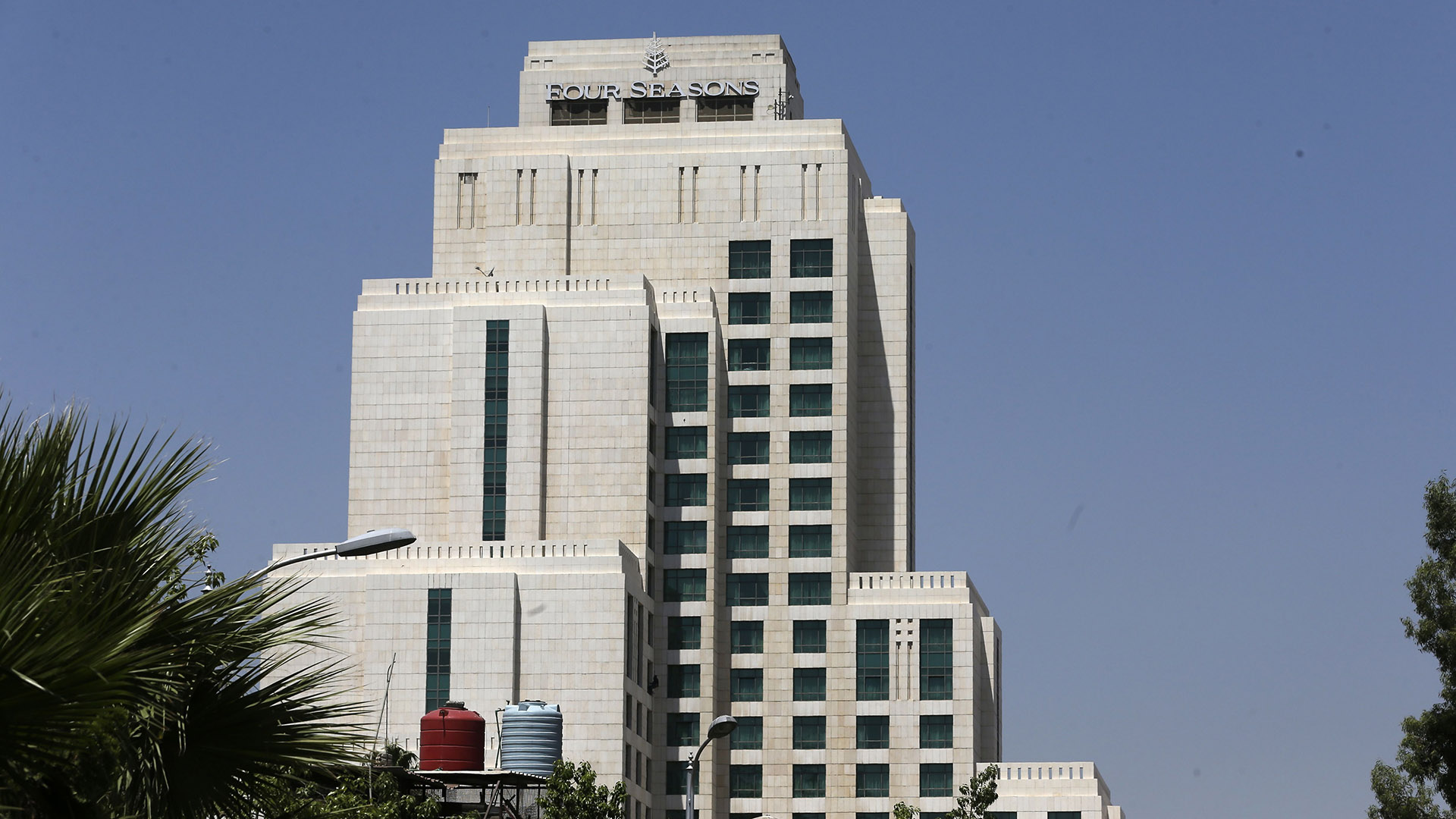
Syrian officials have spoken publicly about their settlement with the owner of Damascus’ Four Seasons Hotel, which — together with its holding company — received roughly $4 million in U.N. contracts in 2025. The hotel serves as the headquarters of the U.N. mission in Syria, and was also the initial base of operations for the government committee charged with striking deals with these businessmen.
The hotel was owned during the Assad era by Samer Foz, an oligarch sanctioned by the United States and EU for profiting from Syrians’ displacement and funding a pro-regime militia. Foz was one of the first Assad-linked businessmen to engage in settlement talks with the new government, and reportedly struck a deal in which he handed over assets valued at up to $1 billion to the government. A Syrian official announced earlier this year that Foz had transferred 32 of his companies to state control.
Syrian officials have argued that these settlements are necessary to rebuild the country’s broken economy. Not all agree. A December 2025 report by the Observatory of Political and Economic Networks (OPEN) castigated the government’s approach as “grossly non-transparent, not carefully applied, and … jeopardizing efforts to clearly break with Assad’s cronyism.”
The report identified 17 sanctioned businessmen who remained in Syria following Assad’s fall. The government has not announced settlement agreements with many of these figures, who maintain business interests in Syria and abroad. It also found an array of companies sanctioned by the U.S. or European countries for their complicity in Assad’s crimes, and which continued to do business under the new government with no apparent change to their corporate ownership.
Reinoud Leenders, a professor at King’s College London and one of the report’s authors, told ICIJ that the secrecy of the government’s negotiations with Assad-linked businessmen risked undermining the country’s political transition. “That’s not how you push the reset button in a country that’s been under stiff authoritarian rule,” he said.
The easing of U.S. and EU sanctions in Syria has opened the door to an influx of new companies, a development also reflected in U.N. procurement data. The World Food Program’s number of suppliers expanded from roughly 40 to more than 300 companies after Assad’s ouster. The U.N. country team attributed the development in part to “significant improvements in Syria’s operating and market environment,” which allowed the WFP to contract with a wider range of local Syrian businesses.
These new and expanding businesses, however, exist alongside the companies of the country’s former oligarchs.
Syria’s authorities have distinguished between those who committed acts of violence on behalf of the former regime and those who did not. In one of his first statements since taking power, the country’s new leader, Ahmad al-Sharaa, said his government would show tolerance toward citizens “whose hands have not been stained with the blood of the Syrian people.”
Leenders acknowledged that many Assad-linked businessmen were not directly implicated in violence, but questioned whether that absolved them of complicity in the Assad regime’s crimes.
“A lot of the businessmen never fired a shot, as far as we know, or strangled anyone or tortured them,” Leenders said. “But they were directly involved in the whole repressive machinery — they coordinated with the regime and they helped finance it.”