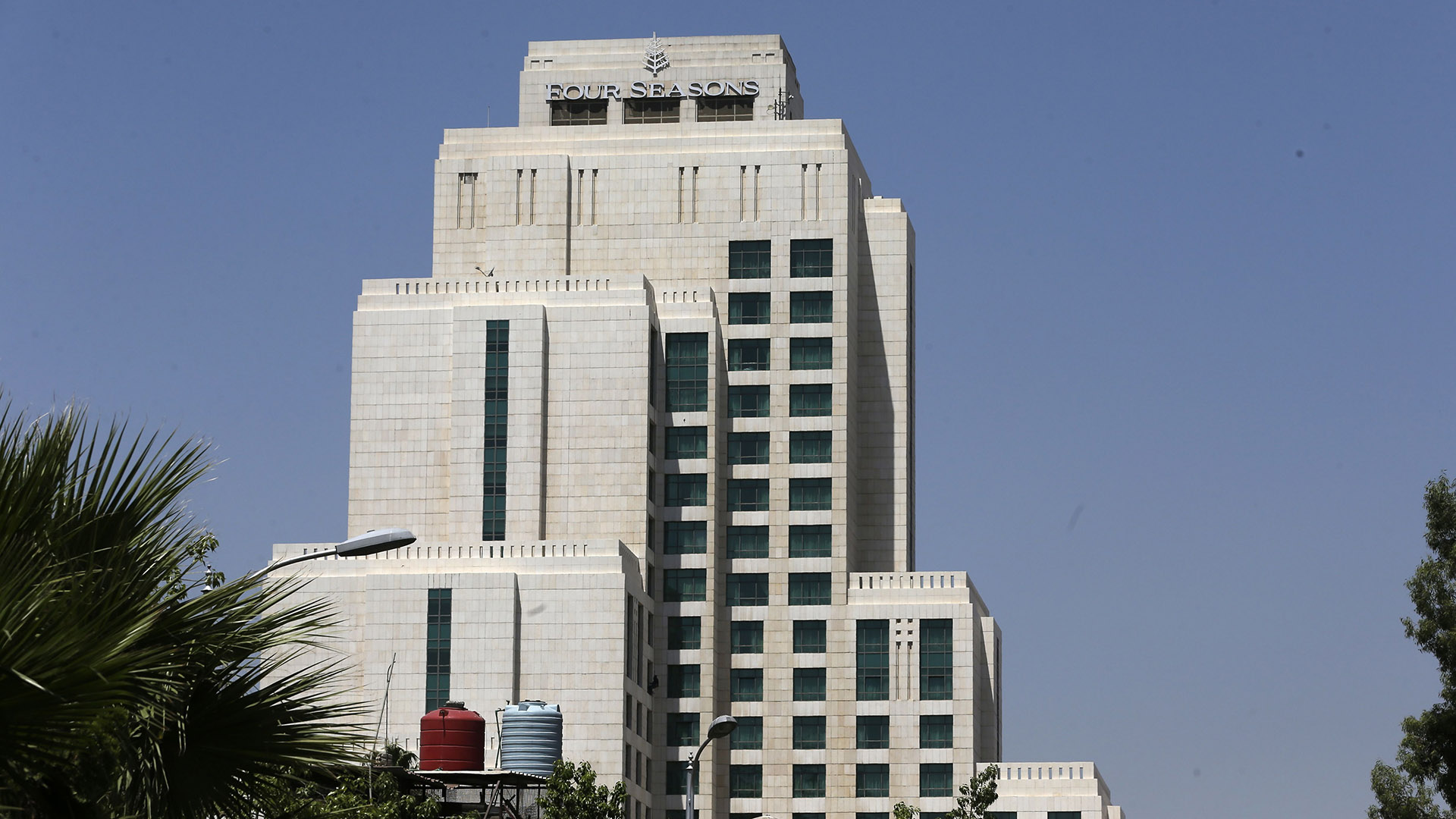
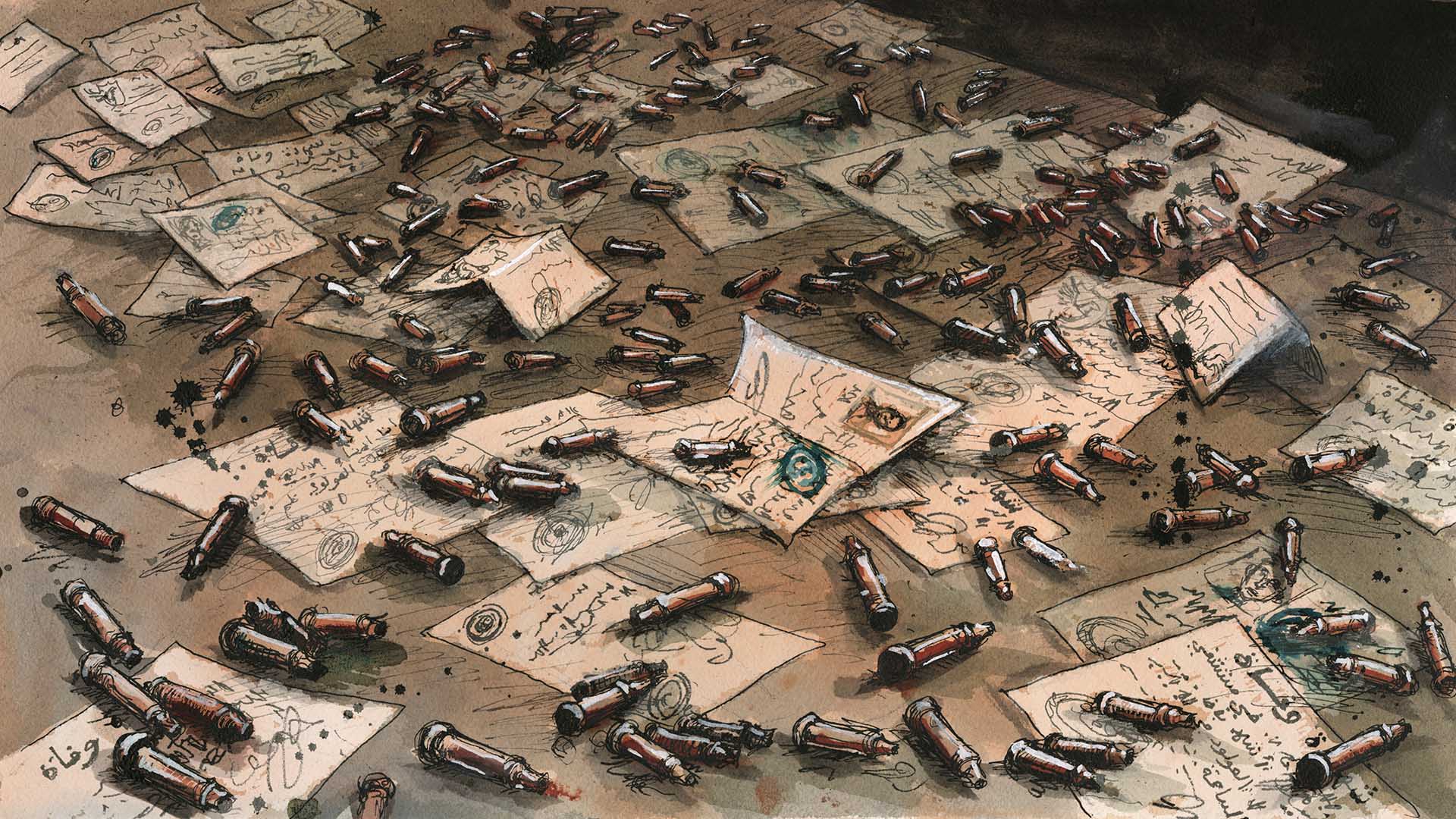
Thaer al-Najjar sat in a cramped basement office in a Damascus hotel, his hands trembling as he glanced down at a single piece of paper. Only the whirring of a ceiling fan filled the silence.
Al-Najjar’s white beard made him appear older than his 57 years, but his arms still bore the strength of his years as a blacksmith. A reporter had just handed him a document containing three lines of typed Arabic text. He brought his glasses to his eyes, adjusted them carefully and began to read:
While providing treatment to the detainee, Imad Saeed al-Najjar, in the emergency department, he did not respond to resuscitation, despite the continued attempt for 30 minutes until the moment of death.
Al-Najjar opened his mouth to speak but swallowed his words. His face crumpled; he started to sob. Then he rushed out of the fluorescent-lit room, his cries echoing down the corridor.
After a few minutes, he slowly walked back in, clutching the paper of his brother Imad’s death certificate, dated Aug. 14, 2012.


Al-Najjar and his family had searched for Imad for 13 years, ever since Imad was arrested by the former Assad regime’s security forces. Al-Najjar had suspected his older brother died in prison, but until this moment, he didn’t have proof.
When the revolution against President Bashar Assad broke out in 2011, Thaer and Imad al-Najjar, then 44 and 46 years old, supported the peaceful protests calling for the fall of the Syrian regime, Thaer al-Najjar told the International Consortium of Investigative Journalists. After Assad’s security forces started shooting at the protesters, he joined the nascent armed rebellion. Imad suffered from a bone infection and was unable to fight, but the distinction mattered little for Assad’s security forces: Both brothers soon became wanted men.
During one clash with Assad’s forces, Thaer al-Najjar was shot in the back. Every other member of his armed group, he said, was killed in the confrontation. Wounded and increasingly isolated, he and Imad took refuge at their parents’ house in central Damascus. But Thaer al-Najjar soon came to fear that Assad’s forces would come for them, and after a few uneasy nights, he slipped away.
Two days later, his fears were realized. Security officers smashed through the family’s front door, he said, wrestled Imad to the ground and threatened their mother’s life before hauling Imad — along with their younger brother, Eyad — to prison.
Eyad was released after a week, his body bruised all over, al-Najjar said. He died a few days later from the torture he suffered in prison.
The death certificate for Imad — the one al-Najjar held now — showed that Imad died 10 days after the raid on their parents’ home.
During Syria’s 13-year civil war, the Assad regime detained, tortured and killed thousands of the country’s citizens. When the regime finally collapsed in December 2024, thousands of people like al-Najjar renewed their search for their missing loved ones. They flocked to prisons, hospitals and mass grave sites; they rummaged through strewn paperwork and examined bodies in hospital morgues, hoping to find long-lost family members or, at least, a sense of closure about their fates.
Bashar Assad’s fall from power in December 2024 marked the end of a violent 13-year civil war in Syria that left hundreds of thousands of civilians and soldiers dead and millions of citizens displaced.
The Assad dynasty began in the 1970s, when Bashar’s father, Hafez al-Assad, seized power. Hafez turned Syria into a single-party militarized state, and ruled by stoking sectarian differences between the country’s ethnic and religious groups. Upon his death in 2000, the then-34-year-old Bashar became president and began implementing economic policies that benefited his political allies and deepened national divisions.
Assad’s rule came to a head in 2011 during the Arab Spring, when the Syrian revolution erupted. The government responded to mass protests with indiscriminate violence, gunning down protesters and carrying out extrajudicial arrests and killings.
As the situation escalated, Western nations expanded sanctions against Assad and his government.
Facing a convergence of threats— from Syrian rebel troops to Al-Qaeda operatives and Islamic State forces, along with growing global condemnation —, Assad turned to increasingly brutal tactics. Over the next 10 years, his regime deployed chemical weapons and attacked civilian areas in an attempt to force rebels to surrender.
Then, in December 2024, rebel group Hay’at Tahrir al-Sham toppled the Syrian government in a surprise rapid offensive and assumed power. Assad fled to Moscow, where he reportedly remains in exile.
Al-Najjar, who is now a father of four and a grandfather, made several trips with one of his sons to Sednaya Prison, the infamous military complex outside Damascus where the Assad regime murdered thousands of prisoners, to look for Imad. “We went to the cells inside,” al-Najjar said. “Imad was a painter and he used to paint on the walls, so we were looking at the walls, hoping that we could find any of his paintings.”
Like so many families, they came up empty.
“Before the fall of the regime, we lived hoping that he was still alive,” al-Najjar said. “But after the fall of the regime” — and searching in vain for Imad — “we lost hope.”


The Assad regime’s collapse catalyzed “a huge psychological and emotional earthquake” for the families of those killed or detained, said Habib Nassar, a senior human rights officer with the United Nations’ Independent Institution on Missing Persons in the Syrian Arab Republic. The opening of the prisons, he said, was “also the moment when tens of thousands of families realized that their loved ones might not come back ever.”
A year later, grieving families are still grappling with a lack of information about those who disappeared into the regime’s vast prison network. Many say they feel abandoned by the country’s new government and demand immediate action, but officials and investigators say it could take more than a decade to find answers.
The Damascus Dossier — an investigation based on a cache of more than 134,000 Syrian security and intelligence records obtained by German broadcaster NDR and shared with ICIJ and 24 media partners — offers an unprecedented glimpse into the Assad regime’s killing machine. Imad’s killing is one of over 10,000 documented in the files, which include photographs of victims and of death certificates.
This investigation reveals the ghastly evidence of the regime’s crackdown: Tens of thousands of photographs taken by military photographers showing detainees who died in custody. To better understand the realities captured in these images, a team of reporters from ICIJ, NDR, and the German newspaper Süddeutsche Zeitung conducted an analysis of a randomized sample of 540 photographs and found that three in four of the victims bore signs of starvation and nearly two-thirds showed signs of physical harm. Almost half of the bodies were naked, left exposed on the floor or a metal surface.
Each killing represents a shattered family searching for answers and wrestling with their grief and anger about what was stolen from them. But together, these records capture only a fraction of Syria’s suffering — a trauma that will shape its society and politics for generations.
ICIJ and NDR interviewed seven families whose loved ones’ deaths are verified in the records. In some cases, like al-Najjar’s, these records were the first evidence the families received that their relatives had died. NDR shared the victims’ names that appear in the Damascus Dossier with four nongovernmental organizations and intergovernmental organizations in the hopes that they may help other families learn what happened to their loved ones.
The Assad regime engaged in a systematic effort to conceal from the world its torture and murder of Syrian citizens. Security forces spent years moving thousands of bodies from a mass grave in a Damascus suburb to a secret desert location to prevent their discovery, according to a Reuters report. And detainees who died in Damascus prisons were routinely sent to nearby military hospitals, according to a U.N. investigation, where doctors issued medical reports declaring they died of “cardiorespiratory arrest.”
The Damascus Dossier lays bare the bureaucratic apparatus that reduced each detainee’s death to anodyne paperwork designed to mask this campaign of mass murder. Most of the death certificates in the trove of documents were signed by doctors at Harasta and Tishreen Military Hospitals in Damascus, which were known for inhumane treatment of prisoners, and most of them list “cardiorespiratory arrest” or “cardiac arrest” as the cause of death. One former doctor at Harasta told NDR that the death certificates were prepared in advance and simply given to the doctors to sign.
After more than a decade of searching for any sign of his brother, al-Najjar could hardly believe the document in his hands. “Is this an accurate document, or is it possible that it was tampered with?” he asked, his voice etched with disbelief.
The paper was a photograph of the death certificate, taken in one of the former regime’s security branches. Al-Najjar longed desperately to see the original, though he had little hope of finding it.

After Assad was deposed, Syria’s new rulers briefly allowed citizens to photograph documents in the former regime’s security branches but forbade anyone from removing the original documents. As they consolidated power, they closed off access to the former regime’s archives. And while they have launched a commission to uncover the fates of the disappeared, it has left families like al-Najjar’s with no sense of when they might receive the most basic information.
By shutting down access to the archives, the government has concealed records that name not only the victims but also the men culpable in their deaths — information that could reopen wounds that Syria is struggling to mend. Al-Najjar said he wouldn’t seek revenge against remnants of the Assad regime for what they put his family through, with one exception: If he finds the person who killed his brother, he said, “I’ll cut him to pieces.”
Al-Najjar said he would not tell their 90-year-old mother of Imad’s death. She still thought her eldest son may someday come home to her, and he couldn’t bear to take away that hope.
At the height of Syria’s civil war, the scale of death overwhelmed the Assad regime’s prisons and hospitals. Staff at one military hospital reportedly converted a nearby parking lot into a makeshift morgue for the overflow of bodies. The Damascus Dossier captures that institutional collapse: Some files are simply hastily scrawled notes listing the names of dead detainees.
On the back of one sheet, scribbled in blue ink, a single record tells a lifetime of loss: “Yamen Awad al-Khalif … date of arrest 8/27/2012 … death 9/1.”
Al-Khalif’s mother, Naeema Abdullah, 65, had known for years that her son was dead. A family member who worked in the security services informed her 10 months after his death. Knowing, however, is no comfort. Like every other family member interviewed by ICIJ, having a piece of paper marked the beginning, not the end, of the search.


Abdullah believes Yamen and his brother Ayman, another son lost to Syria’s war, lie in mass graves somewhere around Damascus.
“I used to stay up until dawn, just thinking about where they are. Where is Ayman? Where is Yamen? If you killed them, then give them to me,” she told ICIJ. “I just want my children back. Nothing else. Just to disappear with no sign, no trace of them. Why?”
Abdullah lives in a third-floor apartment in Damascus’ Tadamon neighborhood, in one of the area’s few buildings without the pockmarks of shelling. Tadamon was ravaged by vicious fighting during the war, and entire blocks have been pounded into dust. Al-Khalif’s sister Iman also lives in the small apartment, as does his son Mazen, who was orphaned by his father’s death.
Abdullah remembers Yamen, who was 26 years old when he was killed, as a quiet, gentle young man. He did not participate in the early peaceful protests against the regime but joined a rebel group after Assad’s security forces laid siege to their neighborhood.
The family fled Tadamon as the fighting intensified, but Yamen al-Khalif soon returned to continue the fight. Pro-Assad militiamen asked to see his identification card as he crossed Nisreen Street, a major commercial thoroughfare in the neighborhood. The card identified him as originally from Deir ez-Zor, an almost entirely Sunni governorate in northeast Syria that had enthusiastically joined the uprising.

That was enough to seal his fate. When it was clear he would be arrested, al-Khalif realized his only hope was to run. That’s when security forces opened fire. “When they shot him, he took a few steps,” said Abdullah, “then he fell down.” (A friend who’d been with al-Khalif that day escaped arrest and later recounted the story to Abdullah.)
For Abdullah and Iman, their anger at al-Khalif’s fate is bound up in the sectarian divisions that helped fuel Syria’s war. As Abdullah told the story, Iman reproached her for omitting the fact that Nisreen Street was known as a bastion for pro-Assad militiamen, many of whom were Alawites — members of a heterodox Islamic sect. The sect, which includes the Assad family, dominated the senior ranks of the security services under his rule.
“Say everything, don’t be afraid — say the Alawites took him,” Iman told her mother as she recounted the story.
“If you ask me what I hate most, I would say I hate Nisreen Street,” Abdullah replied. “If it were up to me, I would destroy it.”
While Yamen al-Khalif’s family eventually learned of his death, they never received information about his brother Ayman. When Assad still held power, Abdullah and Iman held out hope that Ayman was still alive somewhere in the regime’s network of prisons. At the time, rumors ran wild of secret underground detention centers built below prisons. Perhaps, Abdullah and other families believed, they held the more than 100,000 missing sons and daughters.
After the regime fell, Syrians tore up the floors of the detention centers, finding nothing. Iman also spent weeks searching frantically through prisons and hospitals but uncovered no sign of her brother. All she found was destruction left in the regime’s wake: a small boy who had been kept in a solitary detention cell and a detainee still bleeding from torture inflicted upon him in the regime’s final hours. “All of them had lost their minds,” she said.

The success of the revolution marked, for Abdullah and thousands of other families, the end of the hope of finding their loved ones alive. And that has led not only to demands for tangible things — a body to bury, or financial support — but to long-delayed questions about how to cope with the magnitude of the loss they have suffered. The detainees, Iman said, “became the heartache of the victory.”
One Friday afternoon in September, the residents of a village south of Damascus crowded into a squat concrete building near the town center. Inside, the walls were plastered with posters bearing the photographs of men, women and children, describing them as the “heroic missing martyrs” of the town. More than 400 people were missing.
In one corner of the room Afrah Moussa Hussein, 10, held up photographs of her father and uncle. Her mother, Fatima Ali Hassan, sat beside her. “We know our brothers and sons were tortured and killed,” Fatima said. “We have been talking about the same thing for nine months now, but there is no one to ask for support.”
The event, held in the village of Shabaa, was part of a grassroots movement known as the Truth Tents. The initiative began in the Damascus suburb of Jaramana, launched by families outraged after a community group painted over the walls of prison cells in one of Assad’s detention centers — for reasons that remain unexplained. Detainees often wrote their names and other messages on the walls, and families of the disappeared argued that painting over the writing represented an erasure of potential information about the fates of their relatives.


The Truth Tents have since spread to five other locations, giving families a forum to share their experiences and express their demands of the new government. Amani Abboud, a Truth Tents organizer who suffered years of torture in Assad’s prisons, said the movement had opted for decentralization and refused to take financial support in order to stay rooted in the families’ concerns. “It’s their space to talk,” she said.
The walls of the Truth Tents event in Shabaa were lined with posters bearing the families’ demands. “No justice without revealing the fate [of the missing],” read one. Another pleaded, “I want to know: Where is my father?”
It often falls to Jalal Nofal, a soft-spoken, 62-year-old psychiatrist, to tell families that the investigation will take far longer than they hope. Nofal is one of 12 members of the advisory council for the Syrian government’s National Commission for the Missing, established in May to help citizens discover the fates of disappeared family members. The council also includes lawyers specializing in international humanitarian law, experts in forensic medicine and activists who have devoted their careers to advocating for detained Syrians. Nofal is the only mental health specialist.
“We tell them frankly: We have no answers,” he said over coffee at a Damascus cafe. “To be closer to the answers, it needs at least 10 years.”
Nofal often meets with families of the disappeared at gatherings like the Truth Tents event in Shabaa. Many of these families, he said, wanted to provide DNA samples to match with the remains in the mass graves — work that Syrian institutions don’t have the infrastructure or funding to take on. “To match [the DNA] with the bones, with the tissues of the missing people — it’s a kind of impossibility,” he said.
The Syria Civil Defense, a group tasked with identifying mass graves and excavating remains, had not even begun exhuming bodies as of October. It has already discovered roughly 100 mass graves across Syria — a number that will surely grow. In the best-case scenario, experts from the group estimated, it will take between 10 and 20 years to identify all the grave sites, exhume the bodies and conduct DNA tests.

This protracted timeline angers many Syrians, Nofal acknowledged. Movements like the Truth Tents, he said, can offer a way forward for families — both by reinforcing community bonds to cope with the magnitude of the loss and by strengthening civil society efforts to pressure the commission. “We will work in parallel with your pressure,” Nofal said he tells families.
Abboud, the Truth Tents organizer, said that activists have pressured the commission, but it hasn’t responded to their demands. “[Families] want financial support, they want accountability, they want trials. So why is all of this now postponed?”

Nofal has ambitious hopes for the commission: He’d like to see a national plan for psychosocial support, mobile teams delivering answers to villages across the country, and dedicated teams to investigate and double-check the former regime’s files and mass graves. But these plans offer no help to Syrians searching for answers now. In the absence of information from the government, many have taken it upon themselves to search for any clue to what happened to their loved ones.
Like Thaer al-Najjar, Iman al-Khalif and thousands of other Syrians, Wafa Mustafa, a prominent activist, resorted to searching regime prisons and hospitals to learn more about the fate of her father, who was detained by Assad’s security forces in 2013.
“I never imagined that I’ll be at the Mujtahid Hospital looking at dead bodies to identify my father,” she said. “It’s a form of torture.”


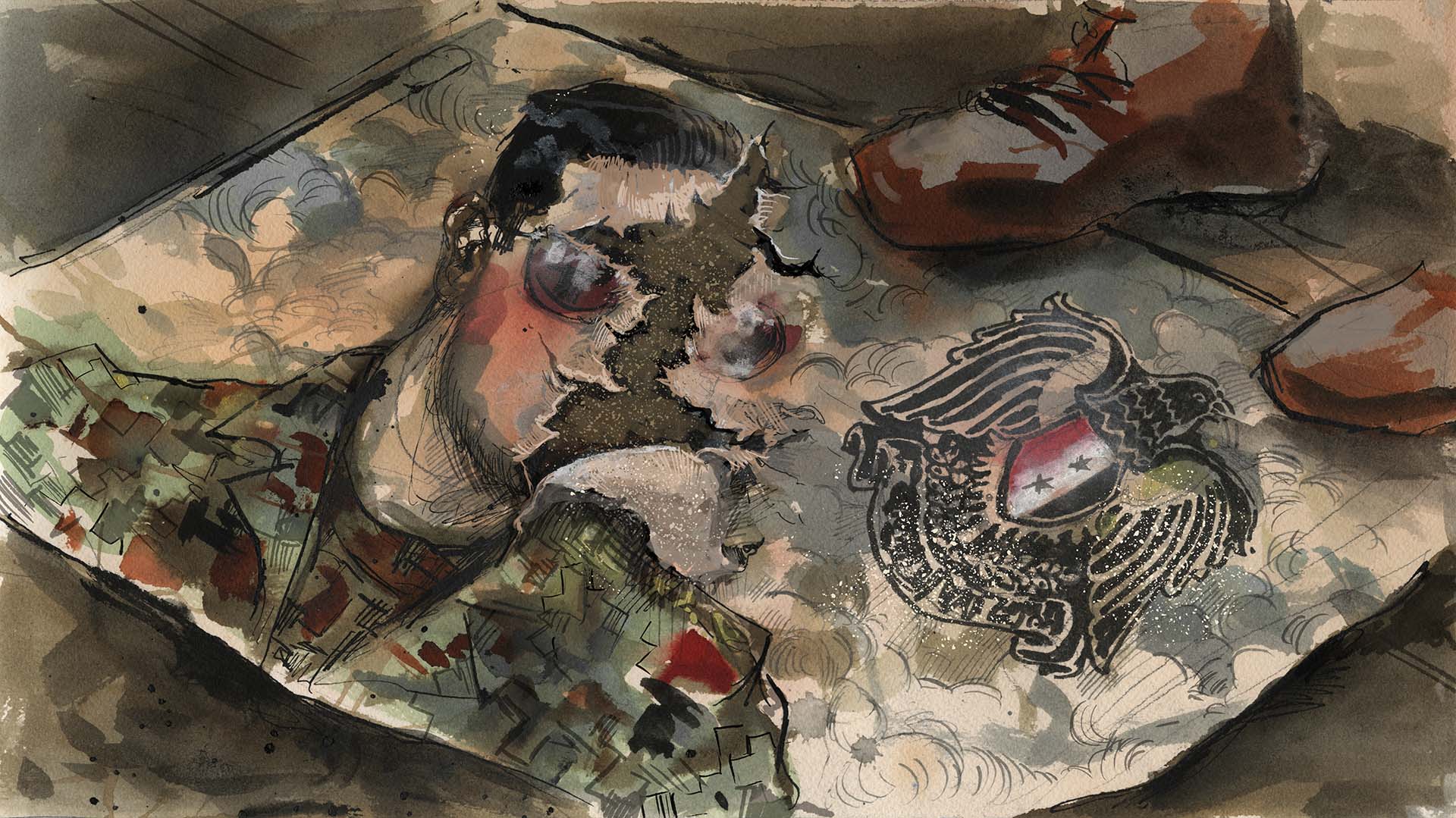
Even as the National Commission for the Missing touts a years-long process to find answers, the Syrian government has failed to take the simplest step: share death certificates and other records in the Assad regime’s archives with families.
Amer Matar and Amr Khito, journalists documenting the former regime’s security apparatus, believe Syria’s new government has no intention of doing so. At a cafe in the Old City of Damascus, the longtime friends said they witnessed the new government mishandling documents from the former regime stored in prisons and security branches.
The government’s policy, said Khito, “looks like a systematic process of destroying evidence against Assad.”
Matar and Khito met nearly two decades ago as students at Damascus University; they started to make documentaries together when the uprising against Assad broke out in 2011. They were eventually arrested, then forced to flee the country in the early years of the revolution, continuing their work from abroad.
When Assad fell in 2024, Matar and Khito seized an opportunity to uncover information about the thousands of Syrians who disappeared in his prisons. They believed they had a brief window to preserve records essential to Syria’s collective memory — documents that would make it impossible for the world to forget what happened there, and that could aid in efforts to bring the perpetrators to justice. They shipped 3D cameras to members of their team in the country so that they could scan the prisons and security branches and photograph hundreds of documents there.

When Matar and Khito returned to the country themselves, they said they witnessed the new authorities not only failing to protect documents but intentionally destroying them. At a branch of Assad’s intelligence services, Matar said, he found fighters affiliated with the new government destroying records there.
Matar confronted one of the men, who told him the documents contained “a lot of problems” — evidence of Syrians informing on their neighbors to Assad’s intelligence services. Matar said he remonstrated the fighters, telling them that those files may contain information about his brother, who went missing in 2013.
“And he told me, ‘Your brother is killed,’ ” Matar said. “And I got crazy. What the fuck, who are you to tell me this?”
After those chaotic early days following Assad’s fall, the window to document the prison network slammed shut. Just as Matar and Khito expected, they lost most of their access to the jails — in part because the new authorities were filling them with prisoners, they said. And as the authorities restricted Syrians’ access, families of the missing found themselves cut off from documents that could have revealed the fates of their relatives.
In that brief time, however, Matar and Khito gathered enough information to create the Syria Prisons Museum, an investigation of the Assad regime’s tools of repression. The virtual museum includes a 3D rendering of the notorious Sednaya Prison, documents that describe how it operated and testimonies from survivors. Matar and Khito plan to expand the museum to other branches of Assad’s security services in the months to come.

After the launch of the virtual museum at the National Museum in Damascus, Matar said, an individual who claimed to be associated with the Interior Ministry threatened him and said the government did not want any regime documents published. Nine days later, Matar was arrested while trying to leave Syria. In a statement following his arrest, an Interior Ministry spokesman said that he was being investigated for “illegally” obtaining documents belonging to security services and exploiting them for personal use.
Matar, speaking to ICIJ from Germany after his release, said an interrogator demanded the photographed files and tried to recruit him as an informant.
“He said, if you will not really tell us everything, we will destroy your image as a journalist,” Matar said. “We will say you stole a document, and nobody will be able to work with you.”
After he spent a night in jail, authorities kept his passport and released him pending an investigation. Ten days later he was cleared to leave Syria. “I think they thought it was easy … to force me to stop doing this work, to give them all the data we have,” Matar said.
Matar’s arrest is the latest sign that the Syrian government sees nothing straightforward about opening the Assad regime’s archives to the families of the disappeared. Those who support the national commission’s approach argued that the new government must confirm any information it shares with families. The regime’s records are transparently false on the cause of death, Nofal argued: How can Syria’s new rulers ask citizens to take them at face value?
But along with the fear that the documents do not reveal enough of the truth is the fear that they reveal all too much. As the fighters Matar confronted had discovered, many documents in the regime’s archives do not just contain the names of its victims, but also its perpetrators — the people Thaer al-Najjar said he would tear apart.

These are not just high-ranking regime officials who may face trial in Syria or abroad, but also ground-level enforcers of Assad’s rule and civilians intimidated into providing information on their neighbors. Putting those documents in the hands of thousands of grieving and angry families, some fear, could unleash a wave of violence that the weak Syrian state could not control.
The search for Syria’s disappeared is a Rorschach test of one’s views on the country’s new government. Those who support its deliberative approach see an appreciation of the limits of the state’s resources and the fragility of the country’s social fabric. Those who believe the government is insincere in addressing the issue of the disappeared, meanwhile, see worrying signs that it is moving to squelch Syrians’ hard-won freedoms.
“I was not afraid to fight [the] Syrian regime,” Matar said. “And now if the new regime wants to build a dictatorship, we can fight. And if they are trying to make us afraid, we will not be afraid.”
Many Syrians neither want to fight the government nor cheer it on. They are simply trying to rebuild their shattered lives, yet feel abandoned by the new authorities.
At the Truth Tents event in Shabaa, Fatima Ali Hassan said that she had lost her husband and her son to Sednaya Prison. She wanted answers about what happened to them and how to pay for all of her daughter Afrah’s education expenses.
“They have formed so many committees to assess the needs of the families,” she said. “But they haven’t looked out for us.”
Contributing reporters: Volkmar Kabisch, Antonius Kempmann, Amir Musawy, Sebastian Pittelkow, Benedikt Strunz, Sulaiman Tadmory (NDR); Benedikt Heubl, Hannah el-Hitami (Süddeutsche Zeitung); Denise Ajiri, Scilla Alecci, Kathleen Cahill, Jelena Cosic, Jesús Escudero, Whitney Joiner, Karrie Kehoe, Delphine Reuter, David Rowell, Angie Wu, Fergus Shiel, Annys Shin, Hamish Boland Rudder, Joanna Robin, Antonio Cucho (ICIJ).
Photos: Aref Tammawi (ICIJ), Espen Rasmussen (VG), Getty Images