
FAQs
Frequently asked questions about the China Capital investigation
How does the Industrial and Commercial Bank of China operate? What did ICIJ uncover in millions of confidential bank records? These questions and more, answered.
What is the China Capital investigation?
China Capital is a cross-border investigation led by the International Consortium of Investigative Journalists that exposes how the world’s biggest bank, the Industrial and Commercial Bank of China, maneuvers behind closed doors to help Beijing achieve its geopolitical goals.
Based on a trove of 4.8 million ICBC records, the investigation reveals that ICBC used its London operations as a financing hub for companies linked to sanctioned Russian and Belarusian business owners, autocrats publicly accused of corruption, debt-ridden states and China’s political establishment. At times, the records show, the bank breached its own sanctions and anti-money laundering policies.
What is the Industrial and Commercial Bank of China?
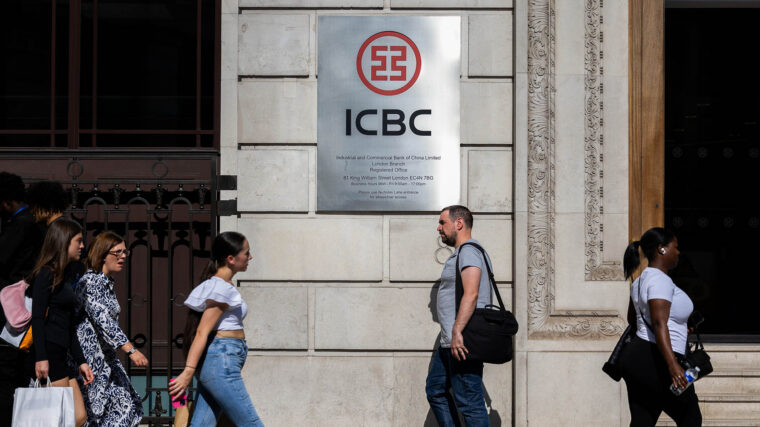
The Industrial and Commercial Bank of China is the world’s largest bank with more than $8 trillion in assets. Unlike its commercial banking peers, ICBC is state-owned. Its majority shareholders are China’s Finance Ministry and a prominent sovereign wealth fund, and it serves Beijing’s interests.
ICBC had 410 subsidiaries and branches in 49 countries and regions by the end of 2025.
What are some of the key findings of the China Capital investigation?
The investigation found ICBC staff in London acted at the direction of the bank’s Beijing headquarters to pursue explicitly political objectives for the Chinese state: cement alliances, acquire natural resources and expand control over communications, energy and transportation infrastructure globally. ICBC London continued to bank — and make exceptions for — high-risk clients even after authorities in more than a dozen countries expressed concerns about ICBC’s compliance and anti-money laundering practices.
ICIJ found that the bank served a surprising number of clients linked to autocrats, oligarchs and Chinese companies with political connections. These included a mining behemoth partly owned by sanctioned Russian oligarchs; a bank owned by the daughters of Azerbaijan’s longtime authoritarian ruler; Angola’s state oil company; and a Chinese company that partnered with a firm sanctioned by the European Union for supporting Belarusian dictator Alexander Lukashenko.
China Capital reveals that in early 2019, not long after the U.S. Justice Department indicted Huawei for allegedly violating sanctions on Iran and other crimes, ICBC bankers in London swiftly transferred a staggering $1.3 billion in “emergency cash” for the tech giant. The transaction, while not illegal, triggered a wave of recriminations and infighting at the bank, particularly from its own financial crime prevention unit, which was not told about the move ahead of time.
ICIJ’s investigation also lays bare what experts describe as the bank’s “muscular” lending tactics, which have burdened some of Africa’s most economically vulnerable states, including Zambia. Years of permissive lending to that country — where Chinese contractors secured loans for Zambia’s government to fund their own projects — ultimately ended in Zambia defaulting in 2020. The default was followed by years of difficult debt restructuring talks and sluggish recovery.
How did ICBC respond to ICIJ’s findings?
ICBC does not list any media relations contact on its website. ICIJ emailed several current and former ICBC employees who did not respond to repeated requests for comment. A reporting partner from The Times personally delivered ICIJ’s questions to the bank’s London office as well but did not receive any response.
What data was used in the China Capital investigation?
China Capital’s rare view of ICBC’s inner workings comes from the confidential archives of the bank’s London branch and a U.K. subsidiary, dated between 2005 and 2024.
The trove includes reports marked as trade secrets; internal emails in English and Chinese; confidential dossiers and lists on more than 4,000 corporate clients; meeting minutes; suspicious transaction logs; and directives from the bank’s Communist Party committee, an internal cell that facilitates party activities and advances government policies.
ICIJ also analyzed agreements related to about 200 loans which ICBC London committed to provide — alone or in coordination with other banks — to nearly 200 borrowers. Among them were the Zambian government and companies headquartered or operating in about 30 countries, including the U.K., South Africa and Luxembourg and some offshore financial centers.
How did ICIJ obtain the China Capital documents?
The 4.8 million records were obtained by hacking groups and later leaked anonymously to ICIJ, which shared them with its media partners after a preliminary analysis concluded that the information was of global public interest.
Who are ICIJ’s partners on the China Capital investigation?
The ICIJ-led investigation included 75 journalists from 24 newsrooms: The Times, Der Spiegel, The Africa Report, The Indian Express, Belarusian Investigative Center, CommonWealth News, Göteborgs-Posten and more.
How can I join an ICIJ investigation?
ICIJ welcomes new offers to collaborate with journalists and prioritizes those with a proven record of high-quality investigations. Journalists seeking to partner with ICIJ should email contact@icij.org. ICIJ only partners with journalists.
How do I get in touch with ICIJ if I want to share a tip or documents?
ICIJ encourages whistleblowers to submit all forms of content that might be of public concern — documents, photos, video clips and story tips — and to do so securely. We accept all information that relates to potential wrongdoing by corporate, government or public service entities in any country, anywhere in the world. We do our utmost to guarantee the confidentiality of our sources.
Find out how to contact us securely here.
Who funds ICIJ?
ICIJ relies entirely on donations to fund our work. Please consider donating to ICIJ.
You can find a list of our recent supporters here.
How do I speak to an ICIJ journalist about the China Capital investigation?
Please direct requests to media@icij.org or call +1 202-808-3310.