A little after sunrise on a cloudy Saturday morning, nine bankers returned to their workplace in London’s financial district for an extraordinary meeting. It was Feb. 2, 2019, and the Lunar New Year holiday would soon halt operations at the Beijing headquarters of the Industrial and Commercial Bank of China.
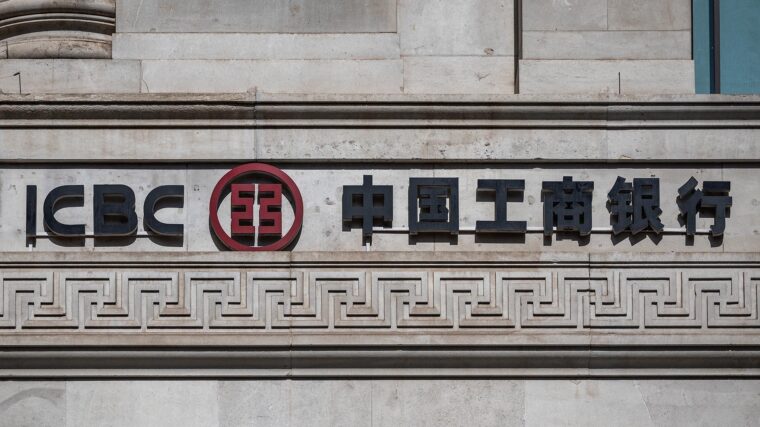
Five thousand miles from the Chinese capital, the bank officers made their way through the lobby of ICBC’s London branch, housed inside an imposing building a short walk from London Bridge. The bank’s managers had called them in on the weekend with a request: Swiftly transfer $1.3 billion for an important client, the Chinese tech giant Huawei.
The company needed to repatriate its “emergency cash,” according to confidential ICBC records reviewed by the International Consortium of Investigative Journalists. The bankers suspected that the urgency might have something to do with a recent scandal making international headlines. “[I]t was probably the negative news,” Chenhu Liu, a senior bank officer who attended the meeting, later told an internal auditor.
Five days earlier, the U.S. Justice Department had unsealed an indictment accusing Huawei of fraud, violating sanctions on Iran and other crimes. (Huawei has denied wrongdoing, and the case is being tried in New York.) The company’s chief financial officer — the founder’s daughter — was under house arrest in Canada after being detained at the request of the U.S.
The incident triggered an unprecedented diplomatic spat as Chinese authorities retaliated by detaining two Canadians on spurious espionage charges. And yet, in London, the criminal case did not deter the ICBC officers from fulfilling Huawei’s request within a matter of hours. The transaction, while not illegal, reveals how readily ICBC’s London branch bypassed ordinary banking protocols to satisfy the demands of its Chinese parent, especially when a strategic client — one that had come to symbolize China’s technological advancement — needed a helping hand.
Huawei was not the only politically connected client to benefit from special treatment at ICBC London. A tranche of 4.8 million confidential bank records spanning 20 years shows how ICBC officers ignored red flags and breached internal anti-money laundering policies under pressure from the bank’s Beijing headquarters. At times, the demands of the Chinese parent led to clashes between eager-to-please managers and compliance officers — the bank’s internal watchdogs — who feared risky clients could jeopardize ICBC’s reputation.
The findings are part of China Capital, an ICIJ investigation with 23 media partners that provides an unprecedented look into how China’s domestic priorities and global ambitions dictate the daily operations of one of its most powerful financial arms. The records, including client dossiers, due diligence reports, meeting minutes and internal emails in English and Chinese, expose the inner workings of ICBC’s U.K. subsidiary and London branch, and the crucial role ICBC London has played in propelling Beijing’s favorites onto the world stage.
The years after Xi Jinping became China’s president in 2013 heralded a golden era in the U.K.’s relationship with the Asian superpower. As it enthusiastically courted Chinese investment, the British government eased rules introduced after the 2008 financial crisis to protect the banking system from international shocks. As long as certain foreign banks served big corporate clients, instead of retail customers, they could open branches in London to move vast sums in and out of Europe.
For ICBC, China’s largest state-owned commercial bank, the changes meant its London branch could rapidly expand under the direction of executives in Beijing whose priorities were, and remain, to serve the Chinese Communist Party and push the president’s agenda. At a time when the Xi administration uses financial statecraft to project power worldwide, China Capital raises questions about the ability of regulators in one of the world’s most prominent financial centers to supervise Chinese state banks effectively. ICBC and Huawei did not respond to ICIJ’s repeated requests for comment.
Martin Thorley, who wrote a book about the party-state’s influence in the U.K., described ICBC and other Chinese banks as a “different beast” compared with their international peers because “they have to make sure they operate within the party’s red lines, and that shapes behavior.” This, he said, presents a challenge to the U.K. and other countries’ security and sovereignty.
“If you’re a Chinese entity and you have to choose between following the guidance of British regulators or the party back home, there is only one winner there, and it’s not the British regulator,” said Thorley, who’s also a senior analyst at the Global Initiative Against Transnational Organized Crime. “It’s an existential question.”
Comrades and bankers
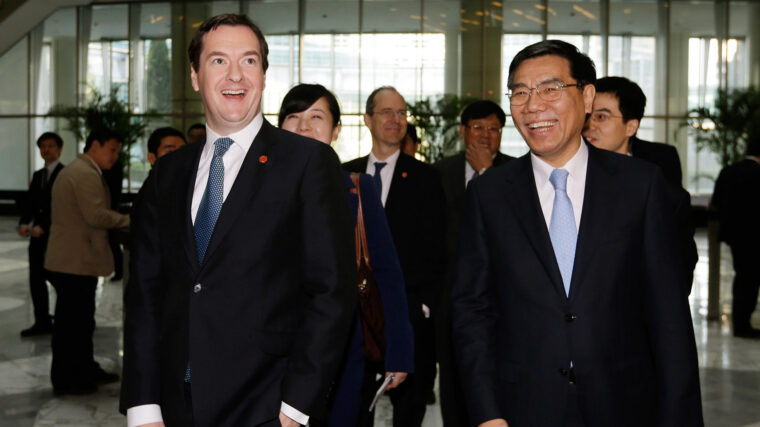
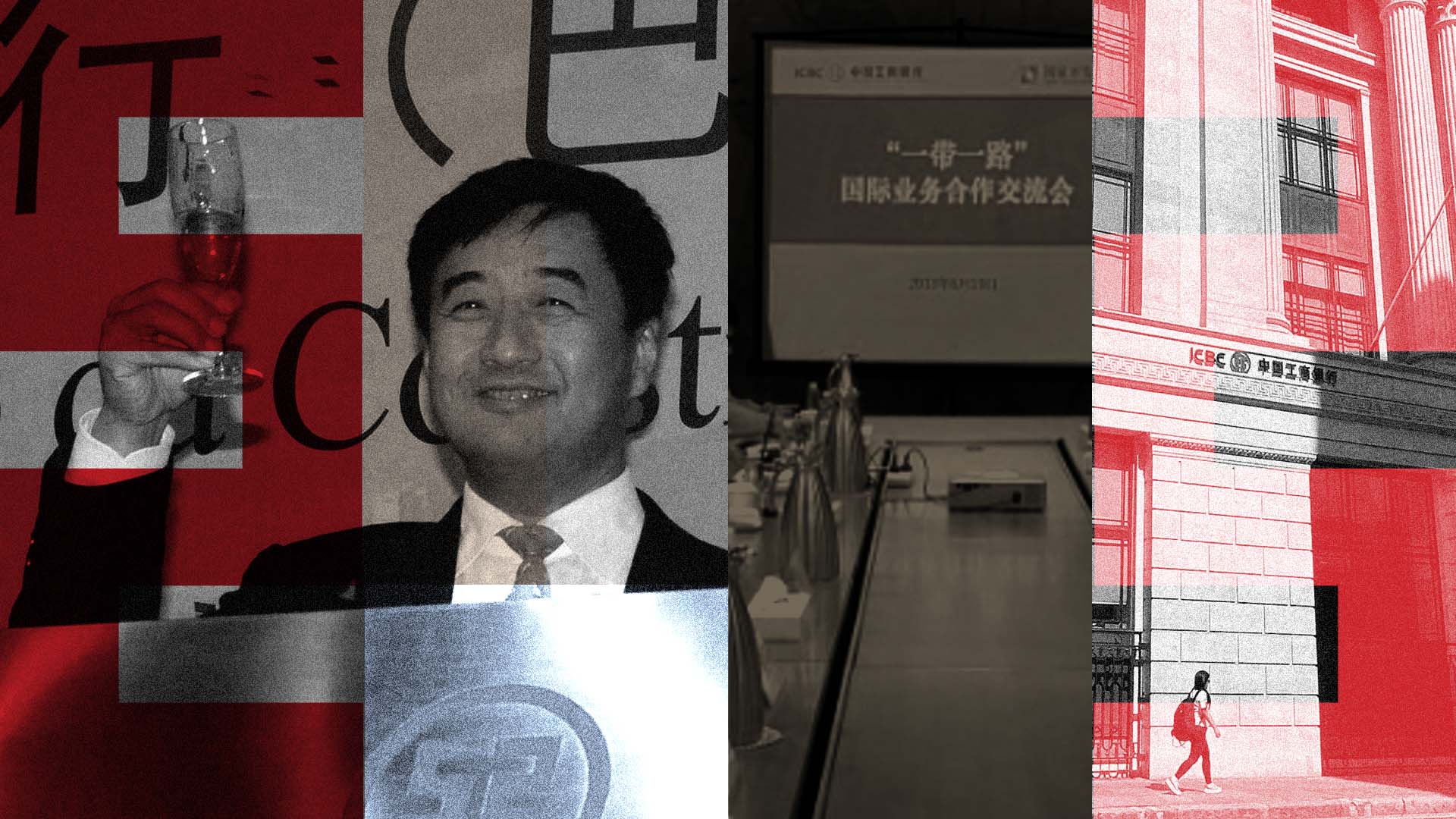
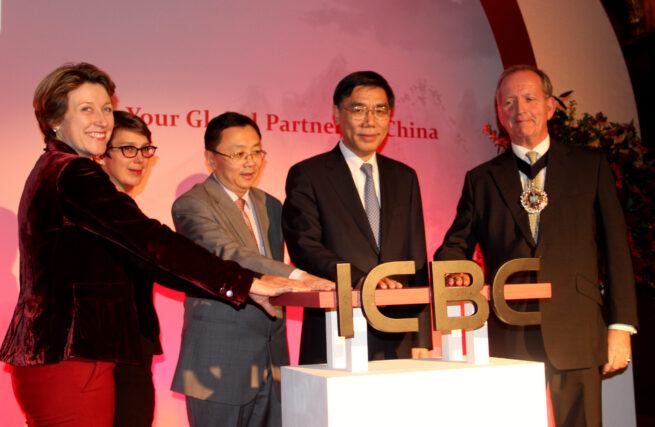
On Dec. 1, 2014, ICBC Chairman Jiang Jianqing and a Chinese Embassy official pressed an oversized red button at a ceremony to declare the bank’s London branch open for business. Gold confetti rained down on guests including the directors of the U.K.’s main banking regulators, who smiled for the cameras as they celebrated the milestone.
ICBC had opened its U.K. subsidiary a decade earlier. But this was the first time it had obtained a branch license under a new supervisory regime. Andrew Bailey, who then helped oversee one of the regulators, the Prudential Regulation Authority, and now serves as Bank of England governor, said publicly at the time that the policy shift was “not a special arrangement for China.” Chinese banks had lobbied for the change, though, which was a boon for ICBC.
Unlike the subsidiary — a legal entity focused solely on retail clients and small firms — ICBC’s London branch could grow rapidly and execute much larger transactions for major corporate clients while remaining under the control of the Chinese parent. A spokesperson for the Prudential Regulation Authority told ICIJ in an email that the agency does “not comment on firms or issues.”
Despite their distinct legal statuses, the two units shared offices a few steps from the famed central bank headquarters, as well as employees, including managers and other staff dispatched from China in addition to locally recruited bankers. The Chinese staff were encouraged to take part in London’s cultural life and promote ICBC’s brand; more than once they joined the Lord Mayor’s Show parade through the city’s streets alongside a pair of panda mascots.
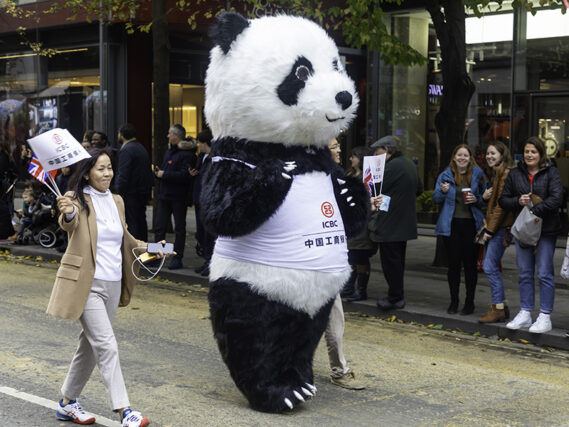
Like most Chinese companies, ICBC has a Communist Party committee, an internal cell that ensures its operations are aligned with — and advance — the party’s interests. Managers at ICBC London, like their peers in China, pledged to implement government policies, the records show. Some Chinese managers appointed to lead the London operations were internally referred to as comrades.
With more than $8 trillion in assets, ICBC is China’s biggest commercial bank, placing it among an elite group of four state-owned financial behemoths so powerful they have become “their own little empires,” according to Daniel Koss, who teaches East Asian politics at Harvard University and has studied Chinese banks. At the same time, the so-called Big Four banks — which also include Bank of China, Agricultural Bank of China and China Construction Bank — adhere to the ruling Communist Party guidelines for two reasons. “There’s the ideological goal, which is to be loyal and understand Xi Jinping’s policy,” Koss said in an interview with ICIJ. “And a more practical one: to get more funding, more credit and approval for politically useful projects.”
When assessing clients, the records show, ICBC London bankers weighed the commercial value of deals against borrowers’ ability to advance Beijing’s economic agenda. This included policies such as Going Global, focused on helping Chinese firms access foreign markets, and the Belt and Road Initiative, a massive infrastructure and influence scheme spearheaded by Xi. In some cases, the bank waived its own anti-money laundering checks.
In 2013, ICBC London saw an attractive client in China Tobacco International, which operates under the State Tobacco Monopoly Administration, according to internal memos. Other banks had shied away from financing unlisted Chinese companies with opaque financial flows. But the state company’s ties to China’s political elite made it particularly appealing to ICBC: The deputy director of the tobacco monopoly was then-Premier Li Keqiang’s younger brother. China Tobacco International could not be reached for comment.
About two years into the relationship — after the branch had financed more than $350 million in trade linked to China Tobacco International — a client review revealed that the branch didn’t have “vital” information on the company’s directors and financials. To renew a loan that promised to yield $3 million of annual income for the bank, ICBC London’s head of commodity and structured finance, Julian Madgett, flew to Raleigh, N.C., to collect one of the missing documents from China Tobacco’s North America office. The company’s U.S. partner, Alliance One International, provided another one. Madgett later described the process as “exhausting” in an email to his colleagues. (Madgett told ICIJ that he no longer works for ICBC and declined to comment.)
ICBC London made an exception to its protocols and signed off on the “recalcitrant” client’s due diligence approvals, despite failing to confirm personal details of two China Tobacco International directors. The deal went through a few weeks later.
Such clashes between compliance staff in London and their managers were common, ICIJ found. Some officers worried that the Chinese headquarters’ more lax standards led their bosses to ignore compliance advice on handling risky clients. But managers warned that the officers’ risk aversion was stifling growth. “Their approach tends to be stricter than necessary, perhaps because they lack a comprehensive understanding of the business,” Xiao Lu, then-deputy general manager of the London subsidiary, said during a 2018 audit. “As a result, they have significantly curtailed the scope of permissible business activities.” (Lu did not respond to ICIJ’s request for comment.)
In reality, the bank’s risk officers had reason for concern. In 2015, along with another bank, ICBC London had approved a $351.5 million loan for a subsidiary of Sanpower, the Chinese real estate conglomerate controlled by Yuan Yafei, a tycoon who was then a member of the Chinese People’s Political Consultative Conference, an advisory body. The former government official turned entrepreneur acquired the British department store chain House of Fraser during a buying spree of Western brands, promising to revive the indebted retailer that had once owned Harrods. Instead, the company soon became insolvent, putting thousands of jobs at risk. ICBC faced a loss of more than $125 million, records show. Sanpower did not respond to ICIJ’s requests for comment.
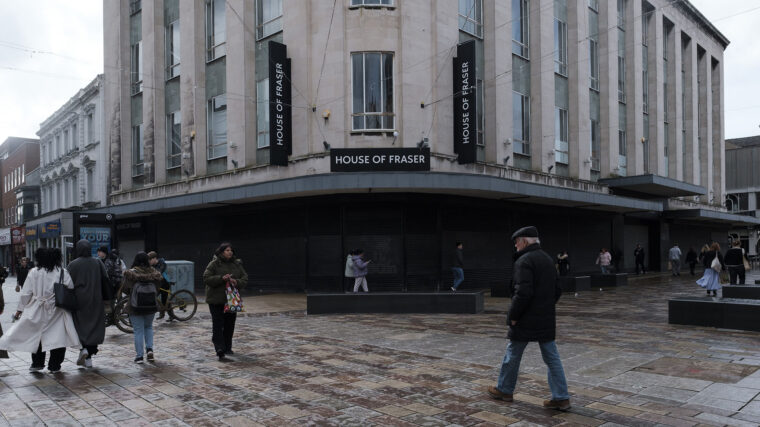
The bank’s London branch recovered at least $29 million in 2019 following a meeting with the client in Nanjing, according to an internal memo. Ruixiang Han, ICBC London’s top executive at the time, explained the reason for the original risky lending decision during an internal meeting: “namely the involvement of a strong Chinese parent, Sanpower.”
‘Strategic customer’
No client tested the relationship between the bank’s compliance officers in London and their managers in Beijing more than Huawei — the symbol of the U.S.-China battle for technological supremacy.
Huawei was founded in 1987 by a former military engineer as a small reseller of imported telephone switches. Within a decade, it prevailed over competitors to supply innovative network equipment to the Chinese army and other government bodies, earning the “national champion” status reserved for firms that bolster Beijing’s strategic aims. The Chinese government backed its international ambitions and used it as a “tool of diplomacy” in developing countries lacking digital infrastructure, according to Antonia Hmaidi, a senior analyst at the Berlin-based Mercator Institute for China Studies.
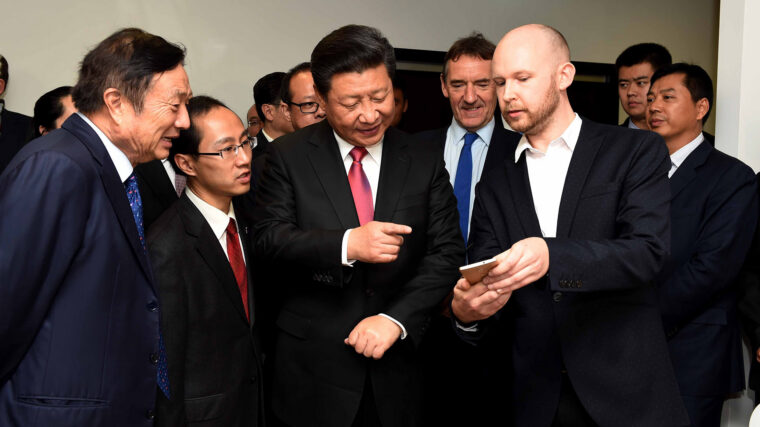
But Huawei’s expansion, at home and abroad, was mired in controversy. The company sold cellphones to consumers and network equipment to the world’s largest telecom operators. It also supplied its technology to oppressive regimes in Iraq and Iran, according to U.S. intelligence. Huawei files also showed the company promoted facial recognition technology that was deployed in China’s Xinjiang autonomous region, where Xi’s government has orchestrated a repression campaign against the Muslim Uyghur minority through mass internment, pervasive surveillance and forced labor.
In the summer of 2018, despite mounting U.S. pressure over concerns Huawei’s networks could be used for espionage, the telecom powerhouse was in full expansion mode. The company is known for its “warrior” culture and a refusal to “admit defeat,” Hmaidi said, and it had the government and state banks at its side.
ICBC considered Huawei “a strategic customer” and provided loans, cash management and other services, the records show. At the time, the company’s account with ICBC’s branch in Shenzhen, where Huawei is headquartered, had an average daily balance of about $1.2 billion and “wealth management products” worth $7.3 billion.
When Huawei opened an account for a U.K. subsidiary with ICBC London, it was classified as a “going out” customer, referring to Chinese companies that need financial support to expand overseas. The subsidiary, Huawei Global Finance UK Ltd., provided financial services to other Huawei entities around the world and increased ICBC London’s total client deposits by about 66%, the records show. Then in December 2018, breaking news triggered an alert in the bank’s internal system, according to an operational incident report and other confidential ICBC records.
Around 11 a.m., on Dec. 1, Meng Wanzhou, Huawei’s CFO and the founder’s daughter, disembarked from a Cathay Pacific flight at Vancouver International Airport. She was waiting to board her connecting flight to Mexico when Canadian border agents stopped her for questioning. Canadian federal police formally arrested her hours later. Closed-circuit television footage from that morning showed Meng wearing comfortable clothing: a T-shirt, dark pants and white shoes. She had no idea that the U.S. had issued a warrant for her arrest on fraud charges related to violations of sanctions against Iran, her father, Ren Zhengfei, later told Canadian media.
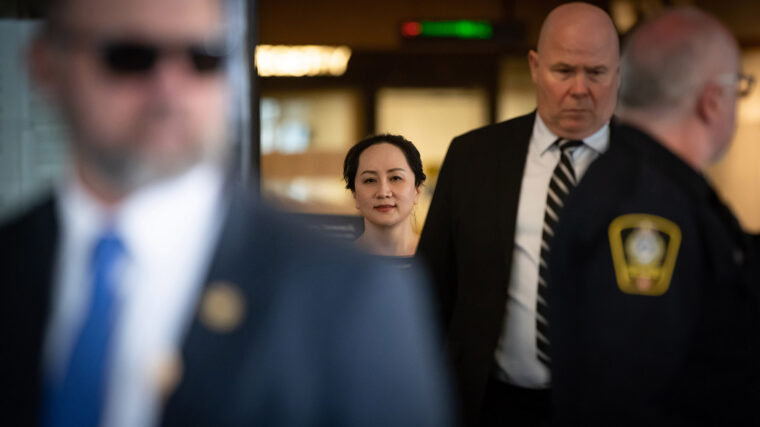
The arrest of such a high-profile executive sent shockwaves around the world. Nine days later, Chinese authorities retaliated by detaining two Canadians in Beijing and Dandong. A Vancouver court soon released Meng under house arrest after payment of her $7.5 million bail. The Canadians — a former diplomat and a consultant — would remain in their prison cells for more than 1,000 days.
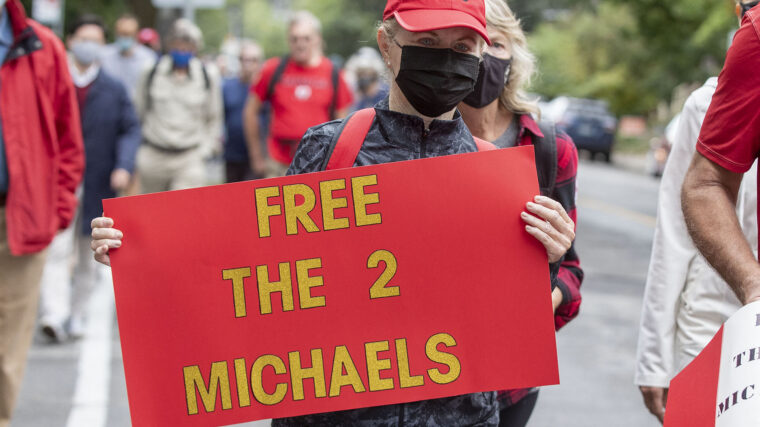
In London, ICBC officers closely monitored the news for nearly two months. Then, a day after the U.S. Justice Department indicted Meng and Huawei for sanctions violations, money laundering and other crimes, the bankers called an emergency meeting. ICBC London compliance officers and senior managers agreed to temporarily suspend business with Huawei until it provided information needed to assess whether its deposited funds were associated with the alleged crimes. Instead of supplying the information, Huawei’s U.K. managers demanded an urgent, in-person meeting with the bankers, the bank records show.
Late Friday afternoon, on Feb. 1, 2019, Huawei representatives visited ICBC London’s office on King William Street with a request, according to a memo detailing the events. Huawei wanted to withdraw all of its subsidiary’s deposits — “quickly.”
During the meeting, two of the bank’s senior managers, Chenhu Liu and Xiao Lu, sought “to prevent the transaction from taking place,” the memo said. Huawei was, after all, one of the branch’s largest depositors, and withdrawing the funds would have amounted to a significant loss. But these efforts “proved fruitless.” Huawei’s executives had already asked the bank’s headquarters in Beijing to approve the transfer. The request had been greenlit.
‘Very high risk’
The following day, at 8 a.m. in London, ICBC executives in Beijing held a conference call with the nine London officers called in to facilitate the transfer. The executives told the bankers that ICBC’s headquarters would ensure the branch had enough funds to finance its operations, according to the bank files. That morning, the officers wired $1.3 billion from Huawei’s ICBC account in London to its account in Shenzhen.
The news of the transfer only reached the branch’s compliance team on Monday, raising alarm bells. Eric Guegan, ICBC London’s money laundering reporting officer at the time, launched an internal investigation and interviewed the officers involved in the transaction over the next two weeks. (Guegan did not respond to ICIJ and The Times’ requests for comment.)
“It is unusual to execute payments outside of London business hours[,] and by mobilising a team to come in on a Saturday to execute significant payments increases the possibility for fraud,” Guegan said, according to an internal memo. He believed his colleagues should have completed a thorough investigation before releasing the funds but noted their decision was made “under pressure from Huawei” and Beijing headquarters.
Guegan flagged that the transfer raised ethical issues: ICBC’s China corporate team had ignored the earlier decision to suspend business with Huawei and executed the transfer without checking if the funds were linked to the alleged crimes. And some of those London officers had not challenged ICBC executives’ view that the U.S. government allegations were unsubstantiated and politically motivated, he wrote. He described their eagerness to please the head office as “unorthodox.”
“There is a possibility that Huawei were seeking to repatriate funds in order to avoid asset freezing by US Sanctions investigators,” Guegan concluded. “The relationship with [head office] requires review and we need to think about when to push back.”
There is a possibility that Huawei were seeking to repatriate funds in order to avoid asset freezing by US Sanctions investigators.
— ICBC London’s money laundering reporting officer in an internal memo
He then emailed ICBC London executives recommending “enhanced due diligence” on Huawei — a standard procedure for customers accused of wrongdoing. Within 15 minutes, Han, the CEO, replied, relaying clear instructions from headquarters: “carry on business with Huawei.” The message echoed an earlier one from ICBC’s Shenzhen branch, which had requested that all ICBC overseas subsidiaries “support Huawei in terms of the opening of new accounts and the possible expansion of business,” according to internal emails.
Indeed, the tech giant wanted to partner with ICBC London to open a new cash account to facilitate the group’s payment of suppliers, payroll and other expenses internationally. Later that month, Huawei’s U.K. managers invited Guegan and four other ICBC London officers for a morning meeting at Huawei’s London office, in a modern skyscraper nearby. Huawei’s compliance manager, Nelson Wang, dialed in from Shenzhen.
Wang explained some of the company’s new policies, underscoring the U.K. subsidiary’s independence and renewed focus on compliance. Huawei, he said, was “not a financial institution but a telecoms company” and therefore had less strict regulatory obligations than a bank. He acknowledged that Huawei was still operating in Syria, as well as two other U.S.-sanctioned countries, Iran and Cuba, where he estimated it made $13 million annually — 1.5% of its global revenue. He added that Huawei may do business with some sanctioned Russian entities but, he said, transactions linked to those activities would be flagged internally and would not go through ICBC London.
The meeting lasted less than two hours. Guegan described it as “cordial” and “held in a transparent manner,” in an internal report. But he had reservations about Huawei’s anti-bribery and corruption policy, which “was not explained convincingly,” he wrote.
Other ICBC branches had their own concerns about keeping Huawei as a client because of its murky ownership structure, the report said. Huawei had claimed that the majority of its shares were then owned by about 100,000 employees through an employee shareholding scheme. “As of today, no independent evidence exists that can verify whether or not the information regarding the ownership and the management of Huawei Union and the Chinese Government’s involvement is factual,” said an internal ICBC London memo. Huawei has long insisted that it’s not state owned or controlled, but U.S. officials and international researchers have questioned whether its executives and shareholders are truly independent.
A few weeks after the meeting at Huawei’s London office, an external due diligence firm concluded that Huawei was a “Very high risk” client for ICBC London because of its alleged links to the Chinese government and corruption, fraud and other criminal allegations in multiple countries, from the U.S. to the Solomon Islands and Brazil. But none of that mattered to ICBC’s executives. In his final report, Guegan wrote that senior management had fought a “sustained campaign” to retain the business. By October 2019, he had resigned.
“I’m sure the pressure would be exerted from all sides to make sure the relationship is working as smoothly as possible and push the boundaries of legal requirements to the limit,” said Graham Barrow, an anti-money laundering expert and former consultant for major banks. “Ultimately [Huawei and ICBC] share the same allegiance, which is back to China,” Barrow told ICIJ.
Lessons learned
Only a year after ICBC London accepted Huawei’s U.K. subsidiary as a promising client, the tech giant’s fortunes had changed. While Meng fought extradition to the U.S., the Trump administration had added Huawei and 68 of its non-U.S. affiliates, including Huawei Global Finance UK, to a list of companies heavily restricted from buying U.S. technology. Under pressure from their most powerful ally, the U.K. and several other countries moved to ban local cell providers from buying Huawei 5G equipment, citing national security concerns.
ICBC remained a valuable ally for the besieged company. The bank opened new accounts for Huawei in Sydney and Frankfurt, according to an internal report. And to show its “commitment” to helping Huawei counter U.S. sanctions and diversify its funding, ICBC became one of the main underwriters in the company’s first domestic bond sale, worth about $850 million. The Chinese government came to the rescue and “ensured their survival,” said Hmaidi, the China tech expert. “No one else would have given them a loan in this situation because no one knew what was going to happen.”
In London, the records show, a group of senior officers reviewed the handling of the Huawei transfer during a conference call with headquarters’ senior bankers and dismissed some of the mistakes as past mishaps. “[The] case demonstrated the bad culture the Bank had at the time,” Robert Clark, ICBC London chief risk officer, told his colleagues. Jingtang Xie, who headed the Overseas Anti Money Laundering Division in Beijing, suggested that the bank introduce new rules to ensure compliance officers had to approve large transactions to avoid similar problems in the future. “Lessons should be learned for the Bank to strengthen future controls,” Xie said.
In response to ICIJ’s questions, Clark, who retired last year, said that ICBC London has always complied with U.K. regulations. In a message to ICIJ, he declined to comment on the Huawei case but noted that “for Head Office in Beijing [Huawei] was and no doubt remains a priority client.” He added: “The sensitivities around Huawei were well-understood in 2019 and … we acted to protect ICBC London from any regulatory breaches.”
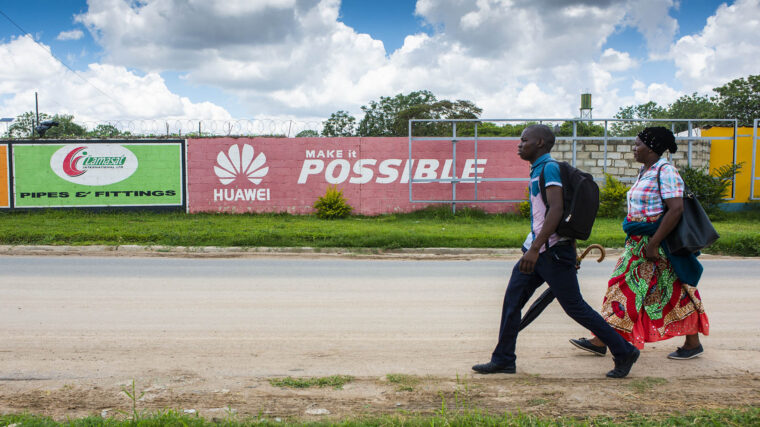
ICBC London ultimately decided to keep Huawei’s U.K. subsidiary as a client and support the company’s global ambitions. In Africa, records show, the bank leveraged Beijing’s influence and trade ties to help some governments acquire Huawei technology by providing financing in renminbi, the Chinese currency. In 2022, ICBC London helped the bank’s Shenzhen branch provide a loan worth about $3 million to a Nigerian bank that was short of U.S. dollars and planned to finance the acquisition of Huawei equipment by MTN Nigeria Communications, one of the country’s largest mobile operators.
ICBC has bankrolled Huawei projects globally for more than 20 years
That same year, ICBC London happily announced in an internal strategy plan: “We have become the cash management bank for clients such as Huawei UK.” Even so, Huawei continued to rely on ICBC’s Beijing headquarters — instead of the bank managers in London — when it needed favors for its U.K. subsidiary.
Huawei remained on the branch’s list of high-risk clients that required additional screening. But in early 2023, the tech giant complained that due diligence requirements were slowing payments. ICBC Beijing managers urgently asked ICBC London officers to speed up the process. “The further [cooperation] between ICBC head office and Huawei group may be effected if we could not offer a more efficient payment resolution to them,” a Beijing officer told a subordinate in London in an email.
ICBC London officers eventually agreed to let Huawei’s transactions go through the account first and then request related information and documents later — just like other ICBC branches in Europe were doing. A bank officer passed on the usual message to her London colleagues: “Head office also mentioned that Huawei is an very important client to them.”
United States v. Huawei Technologies
Last week, lawyers representing Huawei and the U.S. government gathered in a federal courtroom in New York for the opening statements in the high-profile trial that could decide whether the Chinese company is guilty of violating sanctions laws and other crimes.
“The entire business operated through a pattern of theft, lies and cover-ups,” Justice Department attorney Taylor Stout told the court. “For 20 years, that’s how Huawei … abused the American financial system … to dominate the telecommunication industry around the world.” Brian Heberlig, one of Huawei’s defense lawyers, rejected the accusation. “Huawei earned its success,” he said. “There was no blueprint for crime.”
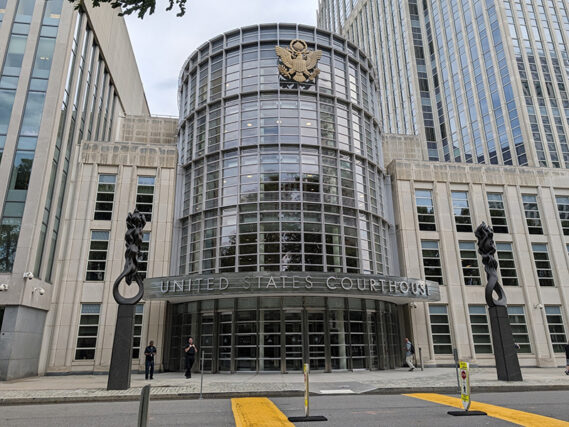
More than seven years have passed since the Justice Department indicted Huawei. Meng was allowed to return to China in 2021 after reaching an agreement with prosecutors in which she admitted to misleading a global financial institution about Huawei’s business in Iran. The charges against her were later dismissed but prosecutors are still expected to submit her admissions as evidence.
The start of the Huawei trial comes ahead of Xi’s scheduled visit to Washington, D.C., to meet with U.S. President Donald Trump to discuss trade and other sensitive topics. Experts told ICIJ that the verdict will not change the fact that Huawei is one of the world’s most influential tech companies.
Since the indictment, the tech giant has provided critical — and cheap — technology to large parts of the world and become a leading firm in the emerging artificial intelligence industry, according to Tim Rühlig, a senior China analyst at the European Union Institute for Security Studies. “Today, these dependencies are giving China leverage,” Rühlig told ICIJ. “There is a vital interest of the party-state that Huawei stays technologically on top, that it is competitive, that it prospers.”
ICIJ’s Denise Ajiri, Agustin Armendariz, Jelena Cosic, Delphine Reuter and Jacob Silverman contributed reporting.