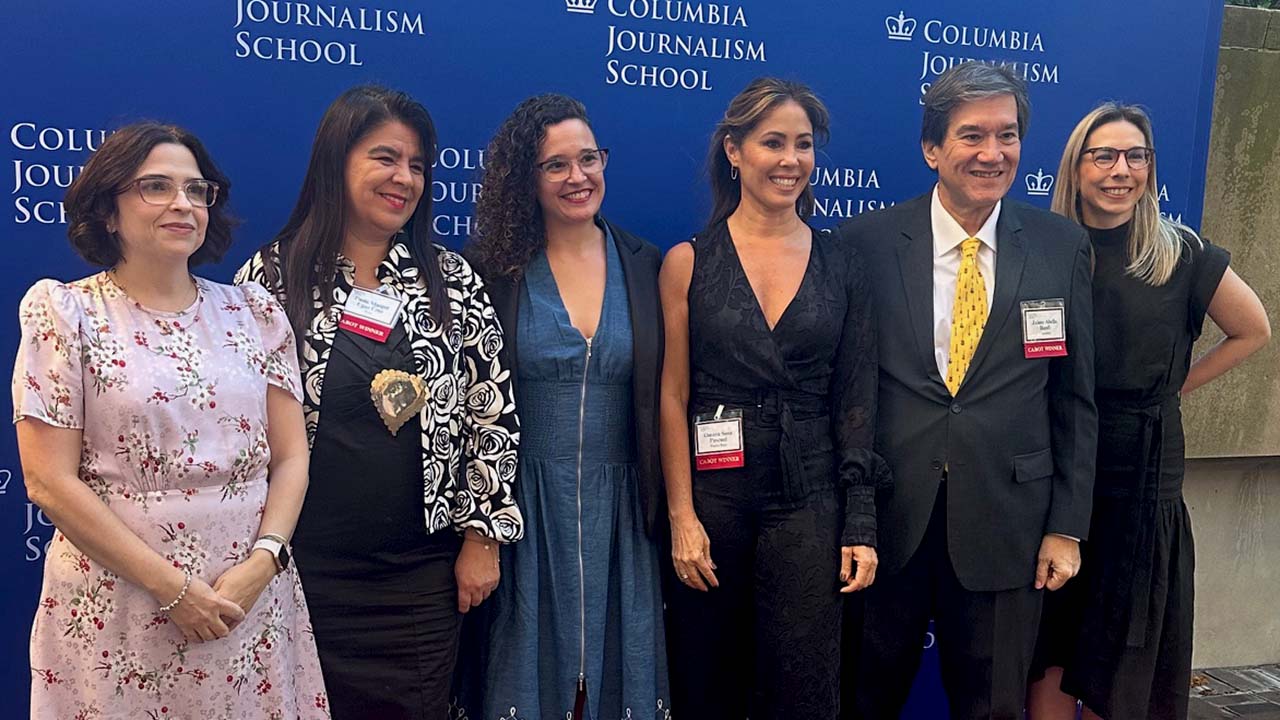
From Mexico to Puerto Rico, Brazil to Miami, the winners of the 2025 Maria Moors Cabot Prize share one thing in common: a track record of working with ICIJ.
The four prize winners — all women for the second time in the award’s 86-year history — were celebrated Wednesday at a ceremony at Columbia University in New York.
- Isabella Cota, ICIJ’s Latin America coordinator and reporter, was honored for her cross-border investigations into corruption and financial crime. Judges said her “insightful business and finance reporting that seeks government accountability is especially valuable amid dramatic changes in economic policies that are reshaping the Americas.”
- Omaya Sosa Pascual, an ICIJ member and co-founder of Puerto Rico’s Center for Investigative Journalism, was honored for her editorial leadership and support for regional journalists. Judges called her a “strong and consistent advocate, writer and speaker for investigative reporting.”
- Natalia Viana, an ICIJ member and co-founder of Brazil’s Agência Pública, was honored for her leadership, innovation and uncompromising journalistic ethic. Judges said she “is the kind of journalist our times demand: a reporter, editor, storyteller and mentor to new generations,”
- Nora Gámez Torres of the Miami Herald and El Nuevo Herald was honored for her coverage of U.S.-Cuba relations and historic developments on the island. She was a key collaborator on ICIJ’s 2019 Bribery Division investigation.
The Cabot Prize, awarded by Columbia Journalism School, celebrates career excellence and reporting that deepens understanding across the Americas. It is the oldest international journalism award in the Americas.
“This year’s sweep by ICIJ-connected journalists speaks volumes about the strength of our global network,” said ICIJ Executive Director Gerard Ryle. “These reporters embody the courage, skill and collaboration it takes to expose wrongdoing, demand accountability and make a difference in people’s lives across the Americas and beyond. We’re proud to see their work honored with one of journalism’s highest prizes, and proud to have them as part of the ICIJ story.”
Abi Wright, executive director of professional prizes at Columbia, underscored their connection to ICIJ investigations. “The 2025 Cabot Prize medalists showcase the strength of the ICIJ and the impact investigative journalism can have on the region and the world.” She noted the breadth of their reporting “from investigating drug-trafficking routes in Costa Rica to exposing billions of dollars misappropriated by the Cuban military; from revealing the true death toll from Hurricane Maria in Puerto Rico to uncovering illegalities in a landmark corruption task force in Brazil.”
Sosa Pascual said her work on Panama Papers and other ICIJ projects shaped her career and prepared her to create a network of Caribbean journalists who collaborate in similar ways.
“The ICIJ experience really helped me to create a system and find a way to work with our own network of journalists,” she said. “It allowed me to understand how to manage people who don’t know each other to create good bullet-proof investigative journalism,” Sosa Pascual said. “The methodology is important but the human part is more important: how you learn to trust each other even if you’re thousands of miles apart and don’t speak the same language.”
Viana, too, said her ICIJ experience contributed to her understanding of how to structure and organize journalistic collaborations, such as the kind her outlet Agência Pública has managed with other outlets in Brazil and beyond.
An ICIJ member since 2018, Viana called the Cabot Prize an indescribable honor that recognizes the strength of independent newsrooms that are “transforming Brazilian journalism while maintaining unwavering commitment to human rights and journalistic integrity.”
Cota sees the award as affirmation that meaningful investigative work can still endure in Mexico’s difficult media landscape.
“It’s recognition that in spite of everything — in spite of a difficult reporting environment and it being one of the most dangerous places in the world to be doing this work — reporters like myself are still working really hard to produce journalism that changes the lives of Mexicans, work that actually has an impact,” she said.